Speaker
Description
Background
This study uses spatially resolved optical emission spectroscopy (OES) in the 205–265 nm range to measure nitric oxide (NO) in hypersonic shock layers over cylinder and wedge geometries in the Sandia Hypersonic Shock Tunnel (HST). The measurements, taken in regions of rapid flow expansion, are fit with NASA NEQAIR and Sandia SPEARS codes to extract NO rotational and vibrational temperatures. These results are compared to direct simulation Monte Carlo (DSMC) predictions to validate thermo-chemical modeling, particularly in regions where thermal non-equilibrium may occur.
Methodology
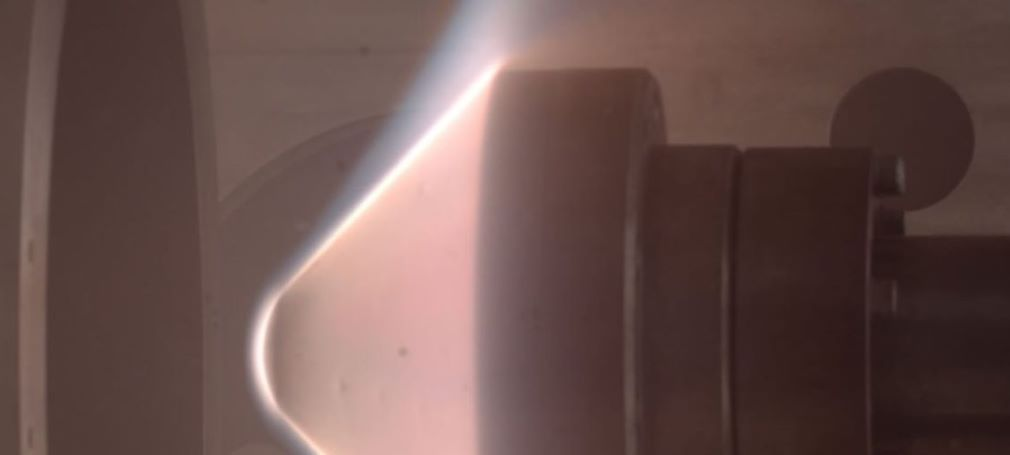
The experiments were conducted in a free-piston shock tunnel, generating high-enthalpy Mach 8–10 flow over a 50.8 mm cylinder and a 50.8 mm square wedge. A $2f$ imaging setup focused the shock layer onto a spectrometer. Measurements were taken along the stagnation streamline and at 30/60-degree angles for the cylinder, and below the expansion corner for the wedge. Spectral fits, using NEQAIR (which includes $\gamma$, $\beta$, $\delta$, $\epsilon$ bands) and SPEARS (which includes the first three via ExoMol), assumed independent vibrational and rotational temperatures, with NEQAIR utilizing a non-Boltzmann quasi-steady-state (QSS) solver.
Results
Repeated measurements confirmed experimental consistency. Initial findings show that while the fitted rotational temperature aligns with DSMC simulations, the vibrational temperatures show discrepancies between models. Specifically, NEQAIR fits for the 30 and 60-degree locations predicted vibrational temperatures $\approx 2000$ K higher than SPEARS and DSMC simulations.
Conclusion
OES measurements validated against DSMC simulations indicate potential non-equilibrium in the expanding flow field. Initial data suggests a discrepancy between NEQAIR and SPEARS in predicting NO vibrational temperatures compared to simulations, which will be further analyzed in the full presentation.
Note
This abstract focuses on the experimental effort, with modeling details discussed in a companion abstract.
Sandia National Laboratories is a multimission laboratory managed and operated by National Technology & Engineering Solutions of Sandia, LLC, a wholly owned subsidiary of Honeywell International Inc., for the U.S. Department of Energy’s National Nuclear Security Administration under contract DE-NA0003525.
Summary
Optical Emission Spectroscopy (OES) measurements were made of nitric oxide (NO) produced within the shock layer for a cylinder and wedge geometry in Sandia’s Hypersonic Shock Tunnel (HST) facility. The collected emission was fit using Sandia’s SPEARS code and NEQAIR to determine line profiles of the vibrational and rotational temperature of NO. Measurements were collected over multiple areas on each geometry and targeted areas of flow expansion where thermodynamic non-equilibrium may occur. Fitted temperatures are compared to DSMC simulations utilizing the latest thermo-chemical models.
Initial results show the fitted rotational temperature agrees with DSMC predictions while the NEQAIR vibrational temperature fits yield temperatures ~2000K higher than the DSMC predictions and the SPEARS vibrational temperature fits. Potential sources of these disagreements and the measurements on the wedge geometry will be discussed in the full presentation.