Speaker
Description
Background of the study
Mars has been the major focus of space exploration and interplanetary travel next only to Earth. The current design process of thermal protection systems for Mars atmospheric entry has large tolerances and uncertainties, which result in the excessive mass of heat shield. One major contributing factor to the uncertainties is the lack of understanding of backshell radiative heating. Mars’ atmosphere is 95.7% $\text{CO}_2$, 2.7% $\text{N}_2$ and 1.6% Ar by volume. In the later parts of the trajectory, closer to the surface of the planet, infrared radiative heating due to $\text{CO}_2$ is a major contributor towards total radiative heating. The conditions here have a relatively low speed ($3-5\text{ km/s}$) of the spacecraft and a higher atmospheric density. These conditions induce recombination of the dissociated $\text{CO}_2$ in the bow shock, resulting in its increased number density along the shoulder and the backshell of the spacecraft. Hence, the total radiative heating here is dominated by radiation due to vibrationally excited recombined $\text{CO}_2$. With future missions to Mars most likely being low speed, human crewed spacecraft, it is crucial to design a safe and efficient spacecraft through better understanding the phenomena taking place in the expanding region.
Due to the limited available literature on the experimental validation of $\text{CO}_2$ in the expanding recombining flows under a non-equilibrium regime, the contribution of $\text{CO}_2$ towards total radiative heating is not fully understood. Expansion tubes offer a powerful tool for generating the real flight aerothermodynamics experienced during planetary entry. The experimental data generated pertaining to such conditions can contribute towards the comprehension of the phenomena taking place in the shock layer around the spacecraft including the radiative heating. This can lead to a reduction in the uncertainties in the modelling.
The goal of this study is to simulate and characterise $\text{CO}_2$ recombination in the conditions representative of Mars low velocity and high density atmospheric entry. The experimental data is taken in UQ’s X2 expansion tube. Midwave infrared emission spectroscopy was used to capture and quantify the $4.3\text{ }\mu\text{m}$ band of $\text{CO}_2$ on a scaled wedge model. To characterise the $\text{CO}_2$ recombination in expanding flows, a 15 species model is developed and added to the Eilmer4 database. The species included are $\text{CO}_2$, $\text{CO}$, $\text{O}_2$, $\text{O}$, $\text{N}_2$, $\text{NO}$, $\text{N}$, $\text{C}$, $\text{O}$, $\text{C}_2$, $\text{CN}$, $\text{C}^+$, $\text{O}^+$, $\text{C}^+$, $\text{e}^-$. Cruden (2018) proposed the most up to date reaction scheme relevant to Mars atmospheric entry. In this work, Park’s and Cruden’s chemical kinetics models are used to predict the non-equilibrium shock layer in the experiments. The numerically predicted radiation will be compared with the measured data for validation purposes. NASA’s radiation modelling code NEQAIR is used to predict and validate the radiation for the proposed conditions.
Methodology
Experimental Setup
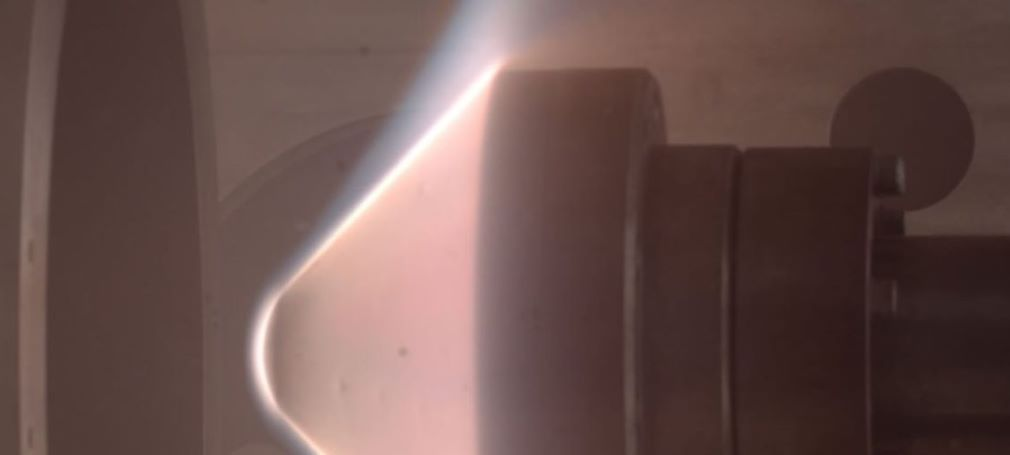
To simulate the non-equilibrium expanding flows, a $54^\circ$ two-dimensional wedge was used to generate a strong shock, post shock compression region and expanding region. The simulated phenomena are representative of the strong bow shock and the corresponding expansion along the shoulder of a spacecraft making an atmospheric entry. The X2 expansion tube is used to create super-orbital flows representative of a planetary entry. The conditions were designed to generate a free stream velocity of $4000\text{ m/s}$, pressure of $400\text{ Pa}$ and density of $2 \times 10^{-3}\text{ kg/m}^3$, which is representative of BET (Best Estimated Trajectory) of the MSL (Mars Science Laboratory) between 80 and 85 seconds.
To capture the $4.3\text{ }\mu\text{m}$ band of $\text{CO}_2$, midwave infrared emission spectroscopy was used. The flow was imaged along a field of view of about $35\text{ mm}$, which captured the freestream, post shock compression region, the expansion fan and the post-expansion region. The imaging system as designed were set to capture the region $4\text{ mm}$ above the shoulder of the wedge model.
Flowfield and Radiation Modeling
UQ’s in-house numerical simulation code, Eilmer4 is used to model the flow using the most updated transport property model and the reaction schemes. The collision integrals’ fit coefficients were generated by curve-fitting the expression proposed by Gupta and Yos using the data provided by Wright et al. NASA’s radiation modeling code, NEQAIR is used for radiation modeling.
Results
Experimental spectra have been generated and calibrated. The calibrated spectra of both the conditions showed an increase in the $4.3\text{ }\mu\text{m}$ band radiance in the shoulder region as compared to the radiance in post shock region, that could be due to recombining $\text{CO}_2$. The authors are working on the validation of the most up-to-date reaction scheme and transport property model using the data obtained through X2 experimentation using Eilmer4 and NEQAIR. This will result in the characterisation of $\text{CO}_2$ in the expanding recombining region. The results will be included in the final presentation.
Conclusion
The conditions representative of low velocity, high density Mars atmospheric entry were designed and generated in the X2 expansion tube in a cold driver configuration. Midwave spectroscopy was used to capture the $4.3\text{ }\mu\text{m}$ band of $\text{CO}_2$. The spectra showed an increased band radiance in the expanding region as compared to post shock region. The results from the flow field and radiation modelling will help validate and characterise the $\text{CO}_2$ recombination for our conditions. The results will allow validation of the proposed numerical scheme.
Summary
The conditions representative of low velocity, high density Mars atmospheric entry were
designed and generated in the X2 expansion tube in a cold driver configuration. Midwave
spectroscopy was used to capture the 4.3 μm band of CO 2 . The spectra showed an
increased band radiance in the expanding region as compared to post shock region. The
results from the flowfield and radiation modeling will help validate and characterise the
CO 2 recombination for our conditions. The results will allow validation of the proposed
numerical schemes.