Workshop topics and outcome
Space, as any other ecosystem, has a finite capacity. The continuous growth of space activities, due to our increasing reliance on services from Space, the privatisation of the space market and the lower cost of deploying smaller and distributed missions in orbit, is from one side improving human-life quality and, however, it is also contributing to overloading this delicate system. International discussion is ongoing at the Inter Agency Debris Coordination Committee and at COPUOS on how to measure the overall capacity of the space environment and assess the impact that individual missions have on it.
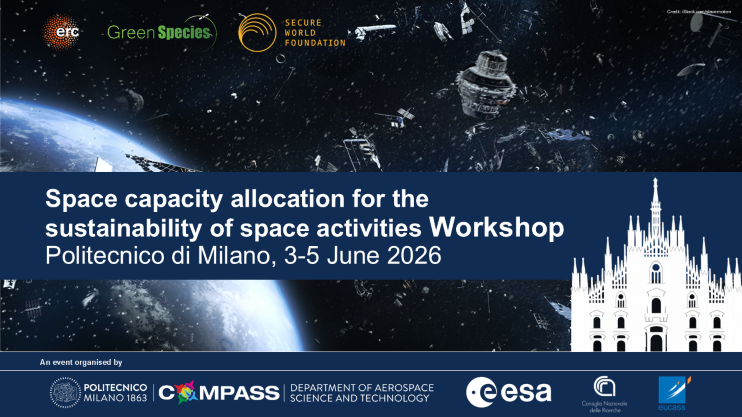
The 2nd Space capacity allocation for the sustainability of space activities workshop will be held in Politecnico di Milano (Italy) on 3-5 June 2026, in Bovisa Campus at the Department of Aerospace Science and Technology.
The workshop is organised by Politecnico di Milano, the European Space Agency, Consiglio Nazionale delle Ricerche (CNR) and EUCASS. The workshop is sponsored by the GREEN SPECIES project funded by the European Research Council lead by Politecnico di Milano and co-sponsored by Secure World Foundation.
This workshop is open to space operators, regulators, researchers working in the space debris field and in space law. The aim is:
- to discuss and compare current advances in research on space capacity modelling and management towards reaching an international agreement on modelling the Space capacity and defining an accepted threshold.
- to offer a constructive and interdisciplinary framework to advance the discussion on space sustainability and space capacity management, including from a legal and economic perspective.
- to engage among the different factors that affect space sustainability at large such-as: long-term orbital capacity, short term slotting for space traffic management, emission into the atmosphere at re-entry and launch, integration between re-entry and air traffic control, light pollution by orbiting spacecraft.
In this view, the following topics will be addressed and discussed during the workshop:
- Modelling of the long-term evolution of the space object population environment and challenges in the forecast of the future launch traffic and technology development scenarios;
- Analysis on how mitigation guidelines can adapt to the change in the launch trend and the increase of large constellations;
- Comparing indices to assess the impact of missions to the space debris environment;
- Measuring and defining thresholds for the overall space carrying capacity;
- Proposals to manage the space environment on the long-term;
- In additional to orbital pollution, discuss how to integrate different indicators such as light pollution, atmosphere emissions, casualty risk at re-entry, etc.;
- Policy studies on space debris mitigations and applicability of capacity management strategies;
- Economic studies on space debris mitigations and applicability of capacity management strategies.
As outcome of the workshop, a special issue of the Journal of Space Safety Engineering will be initiated with invited publications. In addition, a report and statement to be shared with the outcome of the discussion will be prepared. EUCASS will sponsor the best space sustainability student award for PhD students.
Workshop organisation
The workshop will be organised in presence only, with presentations by participants alternating with working sessions and discussions. Some presentations will be also broadcasted for remote participants.
Agenda
Wednesday, June 3rd
09:00-09:30: Registration
09:30-11:30: Session 1: “Is Space debris an environmental problem?”
- Introduction
- Keynote: "Control of climate and space capacity allocation: what are the commonalities"
- Discussions on similarities and differences with space debris
11:30-13:00: Session 2: “Challenges of space debris modelling”
Presentations:
Covered topic: Modelling of the long-term evolution of the space object population environment and challenges in the forecast of the future launch traffic and technology development scenarios.
13:00-14:30: Lunch
14:30-16:00: Session 3: Workshop “Space debris modelling workshop”
16:00-17:30: Session 4: “How space debris mitigation can adapt to the space environment?”
Presentations:
Covered topic: Analysis on how mitigation guideline can adapt to the change in the launch trend and the increase of large constellations.
18:00-20:00: Opening buffet
Thursday, June 4th
09:00-10.30: Session 5: “How to assess the impact of space missions onto the space environment?”
Presentations:
Covered topic: Comparing indices to assess the impact of missions to the space debris environment.
10:30-12:00: Session 6: “How to measure the space capacity?”
Presentations:
Covered topic: Measuring and defining thresholds for the overall space carrying capacity.
12:00-13:00: Session 7: Workshop: “Space capacity workshop”
13:00-14:30: Lunch
14:30-16:00: Session 8: Workshop: “How technical mitigation actions can be translated in policies?”
16:00-17.30: Session 9: “Space debris mitigation policies”
Presentations:
Covered topic: Policy studies on space debris mitigations and applicability of capacity management strategies.
17:30-18:00: Wrap up
19:30-21:00: Dinner (upon registration)
Friday, June 5th
09:00-10:30: Session 10: Panel “Space debris and space capacity measures in the EU space act and international cooperation”
10:30-11:00: Discussion
11:00-12:30: Session 11: “Space capacity management”
Presentations:
Covered topics:
-
- Proposals to manage the space environment on the long-term,
- Economic studies on space debris mitigations and applicability of capacity management strategies.
12:30-14:00: Lunch
14:00-15:30: Session 12: “Towards the integration of all the open aspects in space sustainability”
Presentations:
Covered topics:
-
- Integrate different indicators such as light pollution, atmosphere emissions, casualty risk at re-entry, etc.
- Life cycle assessment of space missions
15:30-17:00: Session 13: Workshop: “Conclusions and next steps”