9th International Workshop on Radiation of High Temperature Gases for Space Missions
Auditório
Biblioteca Municipal - Santa Maria - Azores -Portugal
The workshop is organized by the Working Group “Radiation of High Temperature Gas” (WG RHTG) managed by ESA,through the ESA Technology Directorate, CNES and NASA Ames. The local organization for this event is managed by the Technical University of Lisbon and the Portuguese Space Agency.
The Workshop is devoted to promoting a dialogue on the state of the art and recent advances for simulation/modelling and experimental techniques of hypersonic radiating gas flows. In this frame, a limited number of test cases will be validated with respect to efficiency and accuracy of different methods and experimental approaches, for the determination of radiative heat fluxes encountered during atmospheric entry. The workshop provides the opportunity to explore related areas of research to face the challenges of future space flight.
- Non-equilibrium chemical kinetics
- Hypersonic flows
- Plasma radiative emission and absorption
- Experimental facilities and experimental techniques
- Experimental and numerical modelling improvements of radiative heat transfer: refinement, verification, validation and comparison for space object re-entry simulation tools
- Test cases proposed for validation
The preliminary timetable is now online.
Please submit your abstract online under the heading "Call for abstracts".
-
-
Opening of the Workshop: Opening
Welcome by Prof. Mario Lino da Silva.
-
1
Welcome by Prof Mario Lino da Silva, local organization, Instituto Superior Técnico
Institute for Plasmas and Nuclear Fusion, Lisbon
-
2
Eng.ª Bárbara Chaves, Mayor of the Vila do Porto
-
3
Engº. Paulo Ricardo Braga Quental, Coordinator Azores Mission Structure for Space
Coordinator Estrutura de Missão dos Açores para o Espaço
-
4
Mr. Eduardo Ferreira, Vice-President of the Portugal Space Agency
-
5
Dr. Louis Walpot, European Space Agency
ESA Overview of the RHTG-9
-
1
-
10:30
Coffee break
-
Collisional Radiative ModellingConvener: Dr Aaron Brandis (AMA Inc / NASA Ames)
-
6
Ab-initio Based Kinetics and Model Reduction for Application to Computational Hypersonics Aerothermodynamics
See Attached File.
Speaker: Prof. Marco Panesi (Center for Hypersonics and Entry Systems Studies / UIUC) -
7
State-to-state Modelling of High-Speed Nitrogen Shocked Flows
The conditions of thermal, chemical and radiative non-equilibrium attained in a pure N2 gas subjected to a strong shock wave were quantified using vibronic-specific state-to-state models.
The Forced-Harmonic-Oscillator model was employed in the computation of rate coefficients for vibrational transition and dissociation of N$_2$ and N$_2^+$ by heavy particle impact. Thermal dissociation rate coefficients of N$_2$(X) were obtained and compared with state-of-the-art experimental results, showing a good agreement. By fitting the curve that represents an exponential gap law to experimentally obtained values for rate coefficients values of several vibronic transitions of N$_2$ reported in the literature, discrepancies of as much as one order of magnitude were obtained.
Shots 19, 20 and 40 of the test 62 of the Ames Electric Arc Shock Tube (EAST) were simulated using the SPARK code. The experimental radiation variables were underestimated by one to two orders of magnitude by the ones obtained in Euler one-dimensional simulations. And sensitivity tests performed on the rate coefficients were not successful in getting a reasonable agreement. The shape of the radiative intensities profiles of the low speed shot was correctly predicted, but not the ones of the higher speed shots which revealed non-null plateaus proceeding peaks. These plateaus were not predicted at all. Strong evidence was found for such discrepancies resulting from the non-modelling of the precursor phenomena, the absorption of radiation emitted by the driver gas and the electric arc, and/or the conduction of heat due to downstream plasma being subjected to a stronger shock wave.
Speaker: Mario Lino da Silva (Instituto de Plasmas e Fusão Nuclear - Instituto Superior Tecnico) -
8
New features of the neqair radiation code
The longest-lived code for predicting shock layer radiation, NEQAIR, is now in its 5th decade of service. Substantial changes to the code have been made over the previous decade, the most recent report of which was at the 5th Workshop on Radiation in High Temperature Gases in 2014, for the version referred to as NEQAIR14. This paper will review some of the improvements made to the NEQAIR code since then, which is now at v15.2. Some of these features are discussed briefly below.
NEQAIR15 and subsequent versions have enabled parallel evaluation of multiple lines of sight. This is accomplished by utilizing the HDF5 file format and placing multiple lines into a single file, LOS.h5, which is used for both input and output. This approach enables straightforward parallel execution both over the number of lines of sight and the number of points per line. For large problems, run-time reduces linearly with the number of nodes deployed since each line is processed independently by a subset of MPI ranks.
Three applications of the multi-line solver are discussed. The first has to do with performing loosely coupled radiation-flowfield solutions. In this case the computed absorption and emission coefficients are used to evaluate the total energy absorbed or emitted at each point, allowing evaluation of the volumetric source term in the flowfield. The second computation is for obtaining heat flux from non-uniform flows, which require integration over spherical co-ordinates. These are of particular interest for evaluating radiation on the vehicle backshell. This 3D option improves the angular integration scheme and allows adaptive line selection that together reduce the number of lines required by about an order of magnitude. The final application is for remote observation, which is essentially the 3D integration problem over a small solid angle. For all three of these computations, data can be stored in the HDF5 file which allows a NEQAIR run to be restarted when it times out, or to add atmospheric absorption or instrument scan functions.
An additional level of parallelism is enabled in NEQAIR15.2 using GPU routines. The GPU parallelism has realized up to 8x speed-up when running on a single core but diminishes as CPU parallelism is increased. For running multi-line simulations, it may be easier to reserve a large number of CPU nodes than to obtain the number of GPU nodes required for similar performance.
A GUI, known as NEQTPY, allows for reading and creating input files, running NEQAIR, and displaying results. A significant feature of NEQTPY is the ability to perform spectral fits to data. The fits can operate on a single line spectrum (radiance vs. wavelength) or a 3D input file with multiple columns of data.
Other new features include improved constants, additional species, more detailed non-Boltzmann modelling, advanced user controls, the ability to read and calculate spectra from HITRAN datafiles, photodissociation and photoionization cross-sections. A “fast” automatic grid option may reduce the size and time of spectral calculations while still maintaining good accuracy for total heat flux.
Speaker: Brett Cruden (AMA Inc/NASA Ames) -
9
Photon monte carlo transport computation for athmospheric (re-)entry
Reentry into Earth’s atmosphere and entry into the Martian atmosphere can yield to significant radiative heat loads experienced by the flight configurations. For an Earth-atmosphere, the gas is normally considered optically transparent, but very high temperatures behind the shock will radiate, especially in thermodynamic non-equilibrium conditions. CO2 is the main constituent of the Mars atmosphere and a complex molecule. This molecule and its dissociative products have the ability to strongly emit and absorb radiative heat loads. In fact, previous investigations [1] revealed radiative heating to be crucial not only for the stagnation point region but also from the wake flow. The shock layer is optically denser compared to a shock layer produced by an earth entry. Therefore, a precise radiative transport computation is necessary to capture the extreme gradients of radiative heat loads in the shock layer.
In [2] early results for the reentry of the Fire II flight experiment in air are discussed. Use was made of the k-correlation method, and the results were validated against the flight measurement and different numerical results. [3] applied a further development of this method for Martian flows. In [1] Navier-Stokes fluid flow computations for the 2D axisymmetric test case TC3 are presented. Here, thermal equilibrium and a mixture of perfect gases were assumed. They use a Photon Monte Carlo Method for radiative transport computation initially developed for turbulent sooty flames. The solver was modified to feature not only a correlated-k but also a statistical narrow band model. They found significant radiative heat loads at the rear part of the entry vehicle mostly due to CO2 infrared radiation. Similar results were obtained in [4] by using a axisymmetric Navier-Stokes non-equilibrium flow computations together with a radiative transport ray-tracing discrete ordinates method.
For this investigation, an efficient Euler-Boundary-Layer method [5, 6] for entry flow computations is used. It features equilibrium and chemical non-equilibrium computations for earth atmosphere and equilibrium computations for a Martian atmosphere. The latest development is the inclusion of a two-temperature model to cover vibrational non-equilibrium in air. Within the last couple of years a Photon Monte Carlo Method called StaRad (Statistical Radiation) is developed and implemented. [7, 8]. In our early investigations we focused on detailed comparisons with analytical methods. Here, we could demonstrate its general capabilities and its computational precision. Recently an investigation about full 3D radiative transport computations of entry shock layers in earth atmosphere [8] was presented. Here, a detailed description of the method and a discussion about advantages and disadvantages from variations of the method is given.
Since the StaRad radiative transport solver can be coupled to many spectral modeling methods and databases such as PARADE, NEQAIR or HITRAN/HITEMP with this investigation aims at applying our computational setup to the Erath and Martian atmosphere entry shock layers. Furthermore, a discussion of other variations of the method for a further development of the general Photon Monte Carlo Method will be given.
Since a very efficient fluid flow computation method and a radiation method of arbitrary accuracy and computational time (exact for the fictitious number of infinite bundles) is used, several computations along an entry trajectory will be performed to gain an insight of the total heat loads along the trajectory accounting for radiation. The frequency possibilities will be discussed.REFERENCES
[1] O. Rouzaud, L. Tesse, T. Soubrie, A. Soufiani, P. Riviere. D. Zeitoun: Influence of radiative heating on a Martian orbiter, J. Thermophys. Heat Transf. 22 (2008), pp. 10-19.
[2] Ch. Mundt, J. Garcia-Garrido, F. Goebel: Implementation of gas radiation models in the CFD code NSMB for the analysis of high enthalpy flows of re-entry problems, 6th International Workshop on Radiation of High Temperature Gases in Atmospheric Entry, 24-28 November 2014, St. Andrews, UK.
[3] J. Garcia, A. Pudsey, Ch. Mundt: Numerical simulations of radiative heat effects in a plasma wind-tunnel flow under Mars entry conditions, Acta Astronautica, vol. 11, pp. 334-341, 2018.
[4] N. Bédon. M. Druguet, P. Boubert; Modelling of radiative fluxes to the heat shield of a Martian orbiter, Int. J. Aerodyn 4 (2014), pp. 154-157.
[5] F. Monnoyer, Ch. Mundt, M. Pfitzner: Calculation of the hypersonic viscous flow past reentry vehicles with an Euler-boundary layer coupling method, AIAA-paper 90-417, 1990.
[6] Ch. Mundt: Calculation of hypersonic, viscous non-equilibrium flows around reentry bodies using a coupled Euler/boundary layer method, AIAA-paper 92-2856, 1992.
[7] J. Bonin, Ch. Mundt: 3d Monte Carlo radiative transport computation for Martian atmospheric entry, 8th Int. workshop on Radiation of high temperature gases for space missions, Madrid, 2019.
[8] J. Bonin, Ch. Mundt: Full 3D Monte Carlo radiative transport for hypersonic entry vehicles,
doi.org/10.2514/1.A34179, 2018 and AIAA Journ. Spacecraft & Rockets, vol. 56, pp. 44-52, 2019.Speaker: Christian Mundt
-
6
-
13:00
Lunch
-
14:30
Visit Tracking Stations Santa Maria
-
-
-
Numerical SimulationsConveners: Dr Louis Walpot (ESA/TEC-MPA), Prof. Christian Mundt
-
10
Simulation of radiating non-equilibrium flows during atmospheric entries using a gas kinetic simulation code
To protect space vehicles of the extreme heat loads during atmospheric entries, appropriate heat shields are necessary. For the higher entry speed class of missions, their design requires the characterization of the both the incident radiative heat flux and associated uncertainties, as well as the impact of radiative cooling in the flow field. An accurate prediction of these properties is also needed for ground testing, since radiation measurements offer a good accessibility to characterize flow fields.
Experimental measurements have shown that thermal and chemical non-equilibrium effects can be crucial for the correct prediction of radiative heat fluxes and interpretation of spectrometric measurements. Computational Fluid Dynamics (CFD) methods, which are typically used for these kind of flow field simulations, are based on Navier–Stokes equations. These equations are physically correct only in a certain range of gas and plasma flows. Strong thermal and chemical non-equilibrium effects found in the region surrounding a bow shock lead to locally high gradients in the flow field. In addition, the backshell protecting the payload from the recirculating flow is subject to rarefaction effects in the wake of the capsule, where continuum assumptions break down. These effects lead to increasing errors in Navier–Stokes-based CFD results and alternative modeling approaches become necessary. The Direct Simulation Monte Carlo (DSMC) method has proven to be an efficient method for calculating these types of flows. Using this well-established approach, it is possible to calculate detailed information about each flow species. Additionally, it is possible to calculate electronic excitation temperatures directly.
In this work, the open source plasma suite PICLas is bidirectionally coupled with a radiation solver. A line-by-line method is implemented to calculate radiative properties in the flow field, a photon Monte Carlo approach is used to calculate the radiative energy transfer. Models to overcome the downsides (computational costs, statistical fluctuations, memory requirements) of the used methods are implemented. Different test and application cases have been simulated and will be shown.Speaker: Julian Beyer (University of Stuttgart) -
11
Assessment of CFD Capabilities of Various In-House Solvers for Modeling Argon Plasma MHD Experiments
Atmospheric entry into a target planet is a critical phase for space missions as the spacecraft must face harsh conditions involving thermal loads in the order of Megawatts. During the entry, the atmospheric gas dissociates and (partly) ionizes. The resulting plasma sheath subjects the spacecraft to high heat fluxes and leads to communication blackout as well. Since both aspects can compromise the safety of the vehicle. Since both aspects can compromise the safety of the vehicle, a design which employs advanced protection systems is necessary to ensure the success of future planetary missions. The charged particles in a plasma flow can be manipulated by applying an adequately high electromagnetic field, which modifies the shock structure and shock standoff distance (SSD), mitigates the heat flux and creates a magnetic windowing effect that can reduce the communication blackout period.
The idea of flow control by this means of an externally applied magnetic field – i.e., the MHD approach – was proposed for the first time in the 1950s. The theoretical idea of MHD flow control is as follows: the magnetic system installed in the spacecraft produces a magnetic field which is applied to the weakly ionized plasma flow, and an electric current is produced in the shock layer. As a result of the interaction between this current and the magnetic field, a Lorentz force is induced, which decelerates the plasma flow in the shock layer and increases the shock standoff distance. This approach can be applied to atmospheric re-entry problems by means of an MHD probe. This concept was not fully developed at the time it was first formulated, because a proper technology to produce an adequate magnetic field was still missing. However, the development of superconductive coils in the last decades opens the possibility to design a flight-capable magnetic shielding device able to face the re-entry flight plasma conditions. In this new technological context, the MHD Enhanced Entry System for Space Transportation (MEESST) Horizon 2020 project will exploit MHD-effects and develop a demonstrator implementing active magnetic shielding by means of a superconductive coil system. MEESST includes experimental campaigns in the plasma wind tunnels of the Von Karman Institute (VKI) and the Institute of Space System (IRS), and numerical simulations relying upon improved models. To explore the use of MHD thermal protection system, numerical tools to predict the behaviour of atmospheric entry plasma flows in thermochemical nonequilibrium (TCNEQ) under the influence of externally applied magnetic fields have been developed as a part of MEESST project. In this work, ground experiments done by Knapp and Kranc in plasma wind tunnel using Argon with MHD have been numerically rebuilt by means of the three in-house CFD codes namely SAMSA (developed by IRS), HANSA (by University of Southampton) and COOLFluiD (by KU Leuven). The results have been compared among the codes and against the available experimental data. The key findings of this work can be summarized as :
1. All the codes present internal consistency of results, i.e. the expected MHD-effects caused by the applied magnetic field on the shock structure and heat flux can be detected.
2. The shock standoff distance increases (all the codes) and the heat flux decreases (COOLFluiD and HANSA);
3. For the Knapp test case, the computed SSDs match well for the un-magnetized case; when applying the magnetic field, the SSDs are the highest for COOLFluiD, the lowest for HANSA and in the middle for SAMSA.
4. For Knapp test case, MIG-distances computed by SAMSA match well with the experimental results from the published works of Knapp, especially for the magnetized cases.
5. For Knapp test case, the heat flux for the 0 magnets case from COOLFluiD simulations is the closest to the available experimental data from Knapp, while HANSA underestimates the value; the heat flux reduction when applying 1 and 6 magnets from COOLFluiD slightly overestimated with respect to the prediction from Knapp, while again HANSA underestimates it.
6. Results from SAMSA, HANSA, COOLFluiD for the percentage increase in SSD against the experimental values by Kranc and the numerical results with LeMans as a function of the magnetic field strength at the stagnation point are compared.
7. For the Kranc test case, the SSD percentage increase calculated by COOLFluiD matches well with the experimental results from Kranc, SAMSA has a coherent behaviour, while HANSA underestimates the results for the lowest magnetic field strength and greatly overestimates them for the highest applied fields.The reason of the discrepancies in the results has been identified to be due to the differences in the implemented chemistry and ionization models of argon and transport properties models. Future works include the improvements of the models implemented by HANSA in order to better harmonize the results of the three codes and achieve a better match of the experimental results and testing the codes for ground experiments with MHD for air etc. , which will further benchmark them for use in re-entry applications. SAMSA will increase the resolution in the boundary layer in order to provide calculations of the heat flux. Moreover, the code will be extended in order to simulate air plasma flows. Finally, the three codes will be employed for numerically rebuilding the experimental simulations of atmospheric Earth re-entry flows performed by the MEESST consortium.
Speaker: Vatsalya Sharma -
12
Numerical investigation of hypersonic aerothermodynamics over a double-cone
Space exploration has become a stronghold in aerospace engineering. Understanding the dynamic behind hypersonic flows is crucial for the design of thermal protection systems of space vehicles. The extremely high flight velocities of such bodies while entering in the atmosphere induce the formation of strong shock waves in front of them: in the downstream region, non equilibrium takes place due to chemical activity and vibrational excitation. One of the most interesting aerodynamic shape object of current efforts is the double-wedge or the double-cone. These shapes present two wall deflections that promote a complex shock structure, resulting in a complicated shock wave/boundary layer interaction. The attached shock generated near the leading edge interacts with the detached shock propagating in front of the second wall, inducing the boundary layer separation near the compression corner. By the years, these geometrical configurations got interest since they represent simplified models of more complex aerodynamics components (wings or fuselage) and their study is currently a major topic.
Given the chemical activity occuring in hypersonic flows, the problem is stiff: at high enthalpy regime, the assumption of perfect gas deteriorates due to molecular dissociation induced by the strong shock waves forming near the body. Also, most of the kinetic energy is converted into internal energy (translational, rotational, vibrational and electronic), leading to thermochemical non equilibrium. In this work, electronic contribution is neglected since the temperature does not exceed 9000 K, threshold value for ionization phenomena. In order to properly treat the non equilibrium, the multitemperature Park model (mT) is employed: it accounts for 5 species neutral air mixture and 17 chemical reactions; furthermore, a Boltzmann distribution governs the population of the vibrational levels. This approach is an affordable compromise between computational cost and accuracy. Nevertheless, when dealing with strong non equilibrium phenomena, the assumption of a Boltzmann distribution is not acceptable and one should reformulate the problem accordingly. In this view, a detailed state-to-state model (StS) is employed. It takes into account all the vibrational levels for molecular oxygen and nitrogen: since each of them is treated as a single species, this model leads to a relevant increment of the total number of species. To overcome such an issue, an MPI-CUDA approach is implemented in the solver to allow for multi-GPU executions.
In order to simulate the hypersonic flow around a double-cone, 2D axis-symmetric Navier-Stokes equations are solved for an oxygen reacting mixture. Steger-Warming flux vector splitting is employed for inviscid fluxes, along with a MUSCL reconstruction ensures second order accuracy; diffusive fluxes are discretized through the generalized Gauss' theorem. Finally, time integration is performed through an explicit third order Runge-Kutta scheme, such that potential unsteady behavior is well captured. Source terms are evaluated through a splitting approach. In the first step, homogeneous equations are solved; in the second step, source terms are computed through an iterative Gauss-Seidel scheme to update the mixture composition. In such a way, the overall time-step size preserves reasonable values and is not affected by the stiffness of the chemistry terms.
In this work, two different flow regime are investigated. The first one presents a low free stream enthalpy value (4 MJ/kg): indeed, it is found that non equilibrium phenomena are not relevant. Also, the flow reaches a steady state. The results obtained through the simulations are in a good agreement with those reported in literature and with experimental measurements in terms of surface heat flux and pressure.
On the contrary, when dealing with a higher enthalpy regime (10 MJ/kg) non equilibrium becomes relevant. Chemical phenomena are very strong since oxygen dissociation starts occurring for temperature values above 2000 K. Numerical results have shown a poor agreement with experiments, as also found by other researchers: in particular, the predicted separation region is much smaller than those evinced during the experiments. In order to assess possible influence of wall chemical activity, a fully catalytic model has been also implemented: the results are still in poor agreement with experimental measurements.
However, it is evident from the simulations that the computed wall pressure presents an important deviation from experimental measurements also downstream of the attached shock generating near the leading edge, where the calculation should be straightforward. This led the authors to investigate the influence of non equilibrium in the free stream conditions: for this reason, simulations of the flow expanding through a nozzle have been performed. It has been found out that the mT model provides different conditions at the exit of the nozzle (namely the free stream conditions of the double-cone flow) with respect to those calculated through the StS model. The new simulations performed starting from the mT nozzle conditions and the StS nozzle conditions highlighted a different shock wave/boundary layer interaction over the double-cone. Specifically, the wall quantities computed through the StS simulations predicted a larger separation region, as expected from the experiments, leading to consider that a StS calculation of the free stream quantities (nozzle expansion) would bring the results much closer to experimental measurements.Speaker: Dr Davide Ninni (Politecnico di Bari)
-
10
-
10:15
Coffee Break
-
Meteorites
-
13
CFD/Radiation analysis of the Chelyabinsk and St Valentine meteoroids
This contribution focuses on the numerical analysis of large meteoroids during their entry into Earth atmosphere. After a survey of the available flight data, two entries of meteoroids have been reconstructed: the Chelyabinsk event that occurred in 2013, and a meteor, which felt in the Atlantic Ocean in February 2016, the Saint-Valentine day. For both meteoroids, the most likely trajectories have been computed with a three-degree-of-freedom trajectory tool. Computations have been then performed using a non-equilibrium Navier-Stokes solver at specific points of the trajectories to determine the temperatures and the composition of the mixture around the meteoroids, as well as the surface heat-flux. The flow-field distributions of Mach number predicted at 31 km of altitude for the St Valentine meteoroid is shown in Figure 1 (Left), while the corresponding VUV spectrum is shown in the right part.
Fig. 1: Left: Mach number distribution at 31 km of altitude for the St Valentine meteoroid; Right: Corresponding VUV spectrum
Then, the SPARK line-by-line radiation code has been selected to post-process the CFD results for predicting the radiative heating. It has to be noted that SPARK capabilities have been extended via an updated database capable of reproducing VUV molecular radiation. The spectra obtained for the St Valentine meteoroid at 80 and 31 km of altitude, highlight the strong contribution of molecular VUV radiation at high altitude as shown in Table 1. Then, comparisons have been carried out between the radiative heating calculated using engineering correlations and the CFD/radiation computations at the different altitudes. The comparison put in evidence the lack of reliability of usual stagnation point correlations particularly at low altitude and high level of stagnation pressure.Table 1: Part of VUV contribution as function as altitude for St Valentine meteoroid
Finally, the last part of this work focuses on the meteoroid demise. Firstly, a qualitative analysis of the thermal response of the meteoroid accounting for the available element on material opacity for the incoming radiation wavelength range has been conducted, in a second step the radiative and convective blockages have been estimated. The final point is to propose a scenario corresponding to the meteoroid demise and supported by the outcome of this work.Speaker: Dr Philippe Reynier (ISA) -
14
Modeling of Hypervelocity Air Flows Up to 25km/s
We have modeled hypervelocity high-temperature flows in the 8--25 km/s range, considering a gas mixture of 15 species (${N_2}$, $O_2$, ${NO}$, \ce{N2+}, \ce{O2+}, ${NO^{+}}$, ${N}$, ${O}$, ${N+}$, ${O^{+}}$, ${N^{++}}$, ${O^{++}}$, ${N^{+++}}$, ${O^{+++}}$, \ce{e-}). Atomic and molecular species internal levels spectroscopic data was compiled, with reconstruction of molecular potential curves and determination of the corresponding rovibronic levels. Partition functions were calculated and the determined thermodynamic properties for those species were updated and fitted to a temperature range up to 100,000 K. For chemical kinetics, the impact of adding double and triple ionization for atoms was also evaluated.
Speaker: Mario Lino da Silva (Instituto de Plasmas e Fusão Nuclear - Instituto Superior Tecnico) -
15
DSMC simulation and spectral analysis of an iron meteorite at 80 km altitude entering Earth’s atmosphere
Observation missions of meteoroids entering the Earth’s atmosphere are conducted regularly. Meanwhile a method to replicate the flight in a ground test facilities has been established. Numerical simulations with subsequent comparison of the spectroscopic data, on the other hand, are not yet widely used in this field. This is mainly due to the complex flow environment which not only includes non-equilibrium radiation, but furthermore the outgassing of species from the meteorite.
In this work, simulations of an atmospheric entry of a meteorite with a diameter of 38 mm are performed. A pure iron sphere is assumed and the size and inflow conditions correspond to the ground testing condition. Using the Direct Simulation Monte Carlo method, one trajectory point at an altitude of 80 km is investigated. It is taken into account that iron outgasses on the meteorite’s surface and thus influences the flow field. The outgassing process is simulated as an inflow boundary on the meteorite’s surface, assuming a constant meteorite shape and composition. Since these iron particles do not enter the shock, but are captured and entrained by the flow, there is a large difference in their electronic excitation temperature, the electronic excitation temperature of the freestream, and the electron temperature. However, iron has many radiative transitions that occur in the expected energy range, so accurate predictions of the excitation temperatures for each species are essential. For this purpose, the open source plasma suite PICLas is coupled with a radiation solver and the radiative energy is iteratively coupled back into the flow field. A line-of-sight radiation transport is performed and results are compared to the ground-to-flight extrapolated experimental measurements.Speaker: Mr Julian Beyer (University of Stuttgart) -
16
Simulation of meteor luminosity based on detailed flow simulations in the continuum and rarefied regimes
Meteoroids are interplanetary rocky objects that can reach entry velocities into the Earth atmosphere up to 72 km/s, leading to a high temperature field around the body, ablating the meteoroid material and triggering a chain of chemical and radiative processes. These physico-chemical phenomena result in the formation of a visible plasma flow around the meteoroid head and along its trail, whose extension is in the order of kilometers even for a mm-size meteoroid.
Composition, mass, and trajectory parameters of meteors can be derived by combining observations with the meteor physics equations. The fidelity of these equations, which rely on heuristic coefficients, significantly affects the accuracy of the properties inferred. Our objective is to present a methodology that can be used to compute the luminosity of a meteor entry based on detailed flow simulations.
In the continuum regime, the Navier–Stokes equations are solved using state-of-the-art physico-chemical models for hypersonic flows. It includes accurate boundary conditions to simulate the surface evaporation of the molten material and coupled flow-radiation effects. Such detailed flow simulations allow for the calculation of luminous efficiency, which can be incorporated into the meteor physics equations. Finally, we integrate the radiative transfer equation over a line of sight from the ground to the meteor to derive the luminosity magnitude. We use the developed methodology to simulate the Lost City bolide, obtaining good agreement between numerical results and observations. The computed color index is more prominent than the observations. This is
attributed to a lack of refractory elements such as calcium in the modeled flow that might originate from the vaporization of droplets in the main trail, a phenomenon currently not included in the model.In the rarefied regime, the Boltzmann kinetic equation is solved by means of a stochastic particle method (Direct Simulation Monte Carlo, or DSMC), including evaporation of the melting meteoroid material and nonequilibrium effects in the gas, in particular ionisation collisions experienced by metals in their encounter with air molecules. A ray-tracing algorithm allows us to extract lines of sight from the DSMC simulation. The radiative transport equation is then solved for an existing observation using NASA’s NEQAIR code along these lines of sight to compute the luminosity reaching a ground observer. The computed total luminosity value is compared to observations by Ceplecha [Bull. Astron. Inst. Czechoslov., 17 (1966)] for a single trajectory point. Preliminary results are encouraging. The radiation emitted by the meteor is assumed to be only due to its vaporized iron material and the populations of electronic energy levels are distributed according to a Boltzmann distribution. The validity of the latter assumption is discussed by means of Quasi-Steady-State detailed chemistry model.
Speaker: Prof. Thierry Magin (von Karman Institute for Fluid Dynamics)
-
13
-
13:00
Lunch
-
Shock Tubes
-
17
Comparison of Equilibrium Radiation Between Shock Tube and Plasma Torch Spectroscopy for Atmospheric Pressure Air
As a vehicle re-enters the Earth’s atmosphere, it will be travelling at hypersonic speeds through the quiescent atmospheric gas for the majority of its journey. Consequently, a bow shock forms ahead of the vehicle, creating a sudden temperature and pressure increase. The post-shock temperatures are high enough to excite internal energy modes of the gas particles and promote dissociation and ionisation reactions. Radiation is then emitted as the high temperature gas tries to attain a new state of thermodynamic equilibrium.
High enthalpy ground testing facilities play a pivotal role in the advancement of understanding shock layer thermochemistry and subsequent radiation emission ahead of an entry vehicle. These effects are critical to understand the convective and radiative heat loads during planet re-entry. Two types of such facilities are shock tubes and plasma torches. The Oxford T6 Stalker Tunnel [1, 2] is a transient facility, able to recreate both the high temperature and aerodynamic environment of the shock layer flow field, though limited to test times on the order of micro-seconds. A recent study by Glenn et al. [3] has acquired data in synthetic air for shock speeds from 5.5 to 7.2 km/s while operating in Aluminium Shock Tube (AST) mode, with post-shock pressure close to 1 bar. Simulations run using NASA’s NEQAIR radiation code [4] underpredict the experimental data. This discrepancy is identified to not be a result of shock deceleration effects, which is fairly minimal for the considered test cases.
In contrast, the École Centrale inductively coupled plasma (ICP) torch is another type of ground test facility capable of reproducing the high static enthalpies experienced in the shock layer of an entry vehicle, though is restricted to subsonic flows and atmospheric pressure. The continuous operation allows for extremely long camera exposure times, ideal for high resolution spectral data [5]. Previous studies have shown the ICP torch to be in a state of local thermodynamic equilibrium [6], making it a good comparison for equilibrium radiance data at atmospheric pressure. Simulations using the SPECAIR radiation code [7] generally show very good agreement to the high resolution spectral radiance data after reconstructing the line of sight across the plasma diameter.
The post-shock temperatures of the 5.5-7.2 km/s T6 AST shots are in the range of temperatures present across the ICP torch plasma diameter. Thus, the same radiating species will be present. Direct comparison between the two facilities can not be made due to the different thermodynamic and aerodynamic environments. Instead, comparisons are performed using the NEQAIR and SPECAIR radiation codes after reconstructing the line of sight through the centre of each facility. Comparison of spectra from each facility to NEQAIR/SPECAIR predictions in the ultraviolet/visible range will provide valuable insight to both the thermochemical processes occurring within air shock layers ahead of entry vehicles, the performance and characteristics of data obtained from each facility type, as well as the capabilities of the two radiation codes.
The full paper will present experimentally attained spectral radiance from both facilities in the UV/Vis range, along with NEQAIR and SPECAIR simulation results.References
[1] Collen, P., "Development of a High-Enthalpy Ground Test Facility for Shock-Layer Radiation," Ph.D. thesis, Univ. of Oxford,, Oxford, UK,, 2021.
[2] Collen, P., Doherty, L. J., Subiah, S. D., Sopek, T., Jahn, I., Gildfind, D., Penty Geraets, R., Gollan, R., Hambidge, C., Morgan, R., et al., "Development and commissioning of the T6 Stalker Tunnel," Experiments in Fluids, vol. 62, no. 11, pp. 1-24, 2021.
[3] Glenn, A. B., Collen, P. L., and McGilvray, M., "Experimental Non-Equilibrium Radiation Measurements for Low-Earth Orbit Return," 2021.
[4] Whiting, E. E., Park, C., Liu, Y., Arnold, J. O., and Paterson, J. A, "NEQAIR96, Nonequilibrium and Equilibrium Radiative Transport and Spectra Program: User’s Manual," 1996.
[5] Casses, C. J., Bertrand, P. J., Jacobs, C., Macdonald, M. E., and Laux, C. O, "Experimental characterization of ultraviolet radiation of air in a high enthalpy plasma torch facility," Progress in Flight Physics, vol. 7, pp. 353-368, 2013.
[6] Laux, C.O., "Optical diagnostics and radiative emission of air plasmas," Ph.D. thesis, Stanford university, 1993.
[7] Laux, C. O., Spence, T., Kruger, C., and Zare, R., "Optical diagnostics of atmospheric pressure air plasmas," Plasma Sources Science and Technology, vol. 12, no. 2, p. 125, 2003.Speaker: Alex Glenn (University of Oxford) -
18
Measurement of Aeroheating of Satellite Components at True Flight Total Enthalpies
At end-of-life, satellites must be de-orbited to comply with guidelines laid out by the Inter-Agency Space Debris Coordination Committee (IADC). Disposal by direct re-entry into Earth’s atmosphere is preferred. The IADC guidelines also state that undue ground risk to people and property must be avoided, and environmental pollution should be minimised. These guidelines are intended to prevent over-crowding of the LEO region, which has accumulated a significant amount of orbital debris since the advent of the space age. Aerothermal heating during re-entry causes satellites to burn up in the Earth’s atmosphere. Occasionally, re-entering bodies fail to burn up completely leading to Earth impact events. One such event occurred in 2001, when a 70 kg tank from a Payload Assist Module - Delta (PAM-D) rocket stage crashed into the Saudi Arabian desert.
Computational models have been developed by space agencies and private corporations to predict re-entry trajectories. Accurate prediction of aerothermal heating in the rarefied slip-transition regime is difficult, particularly when coupled to the high temperature gas effects generated by entry speeds over 6 km/s. There is also a distinct lack of experimental data to verify and improve these models. Most of the re-entry literature focuses on aerodynamically optimal geometries at low total enthalpies and continuum. Very few studies have gathered data at conditions where density and enthalpy are matched to flight.
This paper describes heat transfer experiments in the Oxford T6 Stalker Tunnel, configured in expansion tunnel mode. A new rarefied flow condition was commissioned with a freestream Knudsen number of 0.011. Flow enthalpies in the range 19-22 MJ/kg were achieved, corresponding to flight velocities of 6100-6500 m/s. Post-shock conditions were matched to those expected at altitudes in the range 81-90 km. Scaled flat-faced cylindrical models with a diameter of 10 mm were used to represent satellite tanks. The Macor models were instrumented with platinum thin film heat transfer gauges and coated in a thin silicon dioxide film to insulate them from electrons in the ionised flow. A novel mounting method was developed using a ring to allow mounting of up to 12 models at the same radius in the nozzle, avoiding particulate damage caused in the operation of the expansion tunnel. This ring also allows for variation of angle of attack of the model set, as well as the flexibility to mount models in different orientations. Heat flux measurements are compared to those numerically predicted using the Eilmer 4.0 solver.
The test bed described in this work provides a novel capability in Europe to provide further validation data for satellite demise.
Speaker: James Leader (University of Oxford) -
19
Experimental Simulation of a Galileo Sub-Scale Model at Ice Giant Entry Conditions in the T6 Free-Piston Driven Wind Tunnel
Uranus and Neptune, known collectively as the Ice Giants, are the only two planets in the solar system that are yet to be explored with a dedicated mission. Planetary entry probe missions to the Ice Giants were proposed in 2010 by NASA and ESA which prompted a resurgence of interest in experimental simulation of the aeroheating environment that would be encountered by such a spacecraft. The Oxford T6 Stalker tunnel is the only facility in Europe capable of replicating the high speeds required for Ice Giant entry and is therefore a key stepping stone on the path to realising the goal of an Ice Giant mission.
Although significant progress in Gas Giant entry research has been made in the last ten years, many studies have neglected the influence of trace components such as CH4 on the aeroheating environment. Such trace components are negligible for Jupiter and Saturn, but may exist in much greater quantities on Uranus and Neptune - CH4 is what is believed to give the Ice Giants their distinctive blue colour.
In the present work, a 1:10 scaled model of the Galileo probe has been tested at Ice Giant entry conditions. Conditions for nominal composition (85%$H_2$,15%$He$), Stalker substituted, and nominal composition with methane (0.5% and 5% $CH_4$) gas mixtures have been developed and validated for use with a new expansion nozzle via a pitot rake survey. Test flows with flight equivalent velocities greater than 22 km/s have been produced with test times on the order of 30 $\mu s$. Heat flux into the model for the developed conditions has been inferred from temperature measurements with a series of coaxial thermocouples. High speed video has been captured to allow for measurement of the shock standoff distance during the test time.
This work provides the first ever experimental dataset for Ice Giant entry conditions with CH4 addition and demonstrates a unique capability to simulate Ice Giant entry conditions in Europe.
Speaker: Mr Joseph Steer (University of Oxford)
-
17
-
15:45
Cofffee break
-
Measurement Techniques
-
20
Spectroscopic Signatures of Common Spacecraft Materials under Representative LEO Re-Entry Trajectories
Introduction
The missing understanding of the disintegration of spacecraft structures during the atmospheric entry flight is the main driving parameter for the calculation of ground impact risk. Additionally, the full demise of the spacecraft becomes increasingly important, because of the rapidly increasing number of Low Earth Orbit (LEO) which undergo uncontrolled entry after the mission. The recently launched satellite systems such as Starlink and OneWeb with thousands of satellites have furthermore only short lifetimes of 3-5\,years which again increases the amount of entering space debris. It is of utmost interest for the space industry to predict the re-entry and demise accurately and space debris problems are a main topic of the European Space Agency under the Space Debris Initiative.
One option for the analysis of re-entry processes is the observation of spacecraft during re-entry which gives insight into the processes that dominate fragmentation and ultimately the demise of spacecraft. Another option is to fly on-board systems which analyze the entry in-situ. However, this requires a comparably complex system and the hardware has to be sent to space. Four Re-entry Break-up Recorders (REBR) were flown aboard Japanese and European Spacecraft, of which three acquired data. Finally, the experimental simulation of re-entry demise can be realized in ground testing facilities. In comparison with flight observations, this method allows investigating the particular features of an atmospheric entry leading to the full demise of spacecraft structures.
The High Enthalpy Flow Diagnostics Group participated in almost all airborne re-entry observations using different spectroscopic instrument. We develop diagnostic methods to be applied in ground testing experiments allowing us to assess the material processes in-situ. With a recently installed load cylinder, the simulation of mechanical forces during the aerothermal testing becomes available. Mechanical forces have been largely discounted and thus not included during re-entry simulations aside from a few case-specific, high-level codes.
In this study, material samples of the main structural components used in spacecraft were tested under combined aeromechanical and thermochemical loads. During testing the emission spectra of the stagnation point were observed by an Echelle spectrometer in 250-880nm. The results of the present study show that depending on the mechanical stress and the aerothermal situation, the materials show different features in the spectral data.
Experimental Arrangement
Experiments were conducted in the plasma wind tunnel facility PWK4 at the Institute of Space Systems - IRS at the University of Stuttgart. The facility consists of a cylindrical vacuum vessel with a diameter of 2m and a length of 6m, connected to the central vacuum system with a four-stage pump system that allows static pressures in the range of 1Pa-50kPa. The plasma is generated by the thermal arc-jet plasma generator RB3, allowing for high local specific enthalpy at sufficiently high total pressures. The material samples are 20mm x 5mm flat bars or 10mm diameter round bar samples with a length of 90 mounted between a 5kN electro-mechanical actuator and the movable PWK test platform.
Material samples were prepared from 4 common structural spacecraft materials (Al6060,Al7075,A316,TiAl6V4).
The samples were tested at conditions corresponding to the re-entry of CYGNUS OA-6 with trajectory points mathed between 90km and 60km altitude. During testing the samples were observed with still frame and video imaging, thermal imaging and an echelle spectrometer. The forces and generator conditions were synchronized with the instruments allowing for a time resolved interpretation of the data.Results
Prior to the material failure the bulk material was not visible spectrally in any of the experiments. However all of the materials showed chracteristic and unique spectra. Aluminum samples were chracterized by the emission of Alkali metals with Lithium lines being unique to Al6060. Chromium lines were the strongest radiator in the A316 stainless steel sample while TiAl6V4 is chracterized by the emission of Vanadium. The surface temperature, oxidation state and force dependent emission of these samples will be shown and discussed in the final paper.
Conclusion
The characteristic spectral features of common spacecraft materials can give insight into the failure modes of re-entering spacecraft. This can further the understanding of the processes governing fragmentation and allow the reconstruction of the break-up from spectroscopic data.
Speaker: David Leiser -
21
Characterisation of a spatially resolved vuv spectroscopy system for shock tube flows
Please see attached PDF.
https://indico.esa.int/event/394/contributions/6997/attachments/4720/14473/RHTG_Buquet_et_al_2022[1].pdfKind regards,
Maïlys
title: Design of a Spatially Resolved VUV Spectroscopy System for Shock Tube Flows
source_pdf: RHTG_Buquet_et_al_2022[1].pdf
conversion_note: Two-column PDF linearised to Markdown. Figures inserted inline where captions were detected; extracted figure crops are used where available, page renders are included as backup.
Design Of A Spatially Resolved Vuv Spectroscopy System For Shock
TUBE FLOWS
Maılys Buquet, Alex Glenn, Peter Collen, Benjamin Williams, Matthew McGlivray, and Tobias Hermann
Hypersonics Group, Oxford Thermofluids Institute, University of Oxford, Southwell Building, Osney Mead OX2 0ES
Oxford, United Kingdom1. INTRODUCTION spheres as thin as Mars’, equilibrium states take more
time to be reached. The non-equilibrium component of
the shock layer, where dissociation, ionisation and exciOne of the side effects of using drag to slow-down space- tation are not in equilibrium with their backwards reaccraft during their entry into an atmosphere is the resulting tions, can account for a large proportion of the emitted
substantial heating to the vehicle. The resulting heat flux, radiation [BJC16]. Although critical, the quantity of exwhich can lead to failure of the structure, is strongly influ- isting spectra dataset in the VUV region is limited due to
enced by a change in gas composition due to the sudden its challenging acquisition.
and steep temperature gradient through the shock near
the surface [Jr.19]. These strong thermochemical reac- This paper first describes the experimental arrangement
tions take place within the shock layer, in which the im- and working principle of the VUV spectroscopy system
balance in gas species initially results in a state of non- under development in the Oxford Hypersonics laboratory,
equilibrium where the internal degrees of freedom of the followed by a detailed description of the optical system
gas are excited, heavily influencing radiation. For mis- design and of its analysis through ray-tracing simulation
sions such as Mars return, during which entry veloci- in Section 3. Section 4 explains the calibration and charties can be as high as 15 km.s−1, radiative heating be- acterisation of the system, and Section 5 defines the test
comes the primary source of heat load on the vehicle’s conditions selected through shock tube and nonequilibsurface [BJ14]. As this process involves complex models rium radiative transport and spectra simulations using the
and is computationally expensive, laboratory ground test- simulation tools Poshax3 and NEQAIR for future test
ing can reduce uncertainty by providing validation data. campaign.Shock tube experiments are a tool to recreate these
thermochemical phenomena in a ground-based facility.2. EXPERIMENTAL ARRANGEMENT
Emission spectroscopy can be used to investigate a slug
of gas thermochemically similar to the gas encountered
by the vehicle during re-entry in order to measure radia- This section presents the VUV-system working principle
tive emission and spatially resolve temperature and gas and how it will be used on the T6 Stalker wind tunnel.
species densities. Knowledge of these quantities offers a
better understanding of the flowfield around the vehicle,2.1. Facility
and a better prediction of the contribution from radiative
heat transfer, currently predicted with an uncertainty of
the order of 80% [JMG+13]. This uncertainty leads to The T6 Stalker Tunnel shock tube was previously used
excessive safety margins in the design of thermal protec- to perform emission spectroscopy in the wavelength
tion systems, which amount to a substantial portion of the regime of 300-850 nm to measure radiation in the shock
vehicles’ mass. It is therefore crucial to be able to quan- layer [CDM19a, GCM21, GCJ+]. A VUV emission
tify it. spectroscopic system is currently under development to
use on T6 in its shock tube mode, with the goal to perAs velocity increases, vacuum ultraviolet (VUV) radia- form spectroscopy for shots in the velocity range of 10tion presents an increasing contribution to the total ra- 15 km.s−1.
diance [HLZ+16]. This radiative heat flux arises from
high-energy electronic transitions of atomic nitrogen and The T6 Stalker Tunnel is a high enthalpy ground testing
oxygen, characterised by short wavelengths and strong facility, able to perform as a reflected shock tunnel, an exintensity radiation. By comparing the relative line in- pansion tube, or a shock tube of different diameters. Its
tensities of their multiplets, the ground state densities latter mode is of interest in this paper, but details of the
can be determined, which makes VUV spectral data par- facility’s development were reported in various publicaticularly useful to characterise the flow. As density is tions [CDS+21, SCG+]. A schematic of the tunnel in its
especially low during high-altitude flight, or in atmo- different configurations is shown in Fig.1.
Figure 1. T6 Stalker Tunnel schematic [CDM+19b].The driver section contains a piston separating highpressure reservoir gas and lower-pressure, low molecular weight compression tube gas. The piston is accelerated by the reservoir gas and quickly compresses the
driver gas to high pressure and temperature against a
metal diaphragm separating the driver and the shock tube.
When the diaphragm ruptures, the driver gas is free to expand into the low-pressure test gas, driving a shock wave,
while still compressed by the piston to maintain pressure
in the driver section and avoid expansion waves to travel
downstream and interact with the shock. The slug of gas
following the shock undergoes the same non-equilibrium Figure 2. Schematic of the VUV system’s different parts
thermochemical processes as the stagnation streamline in and of its dynamic features. From top to bottom: VUV
front of a (re-)entering vehicle, allowing investigation of system inserted in the shock tube, bellows and purple sysemitted radiation of interest. tem adjusting for tunnel recoil during a shot, VUV system
extracted from the tunnel. Not to scale.2.2. Working Principle of the VUV spectroscopic
system
Because molecular oxygen and water vapour absorb
VUV wavelengths in ambient air, any acquisition set-up
must operate either using oxygen-free gas or under a high
level of vacuum, the latter being the approach of the current work. The collection optics system is designed to be
contained in vacuum chambers fitted to the shock-tube
via the test section window. The different parts of the
set-up can be seen in the schematic in Fig.2 and in the
CAD model in Fig.3. This system consists of one circular and one square vacuum chamber attached to a VUV
Spectrograph (McPherson 207V). An intensified P43 iStar sCMOS camera is connected to the spectrograph to
record the spectra. The red window holder is attached
to the barrel and allows connection of the VUV system
via the green interface fitter plate. The mounting of the
chambers is separated into a static yellow system which is
fixed to the laboratory floor, and blue and purple dynamic
systems respectively moving in the lateral and axial directions with respect to the main T6 barrel, as shown in
Fig.2. The whole system is pumped down to a low vac- Figure 3. CAD model of the VUV system, inserted (top)
uum level (10−3 Pa range) up to the test section’s win- and extracted (bottom). Purple parts allow for axial
dow using a dry scroll pump (Edwards nXDS10i) and a movement during tunnel recoil, blue parts for lateral
turbopump (Edwards nEXT300D) mounted in series. movement while yellows parts are fixed2.3. T6 experiments and turn-around During tunnel turn-around, the test section’s window and
its insert move together with the VUV system to main-
tain the vacuum isolated on the largest volume possible.
Before being secured to the tunnel, the VUV system can The red window holder stays attached to the barrel, and
be positioned next to the test section and the length of will be reconnected to the interface fitter plate when turnthe legs adjusted for correct alignment of the window around is finished.
with the shock tube’s axis. As can be seen in Fig.4,
the window insert tightly fits in the red window holder
previously bolted to the tunnel. A set of four rod guides
helps to ensure alignment. Once in position, the green2.4. Calibration
interface fitter plate and the red window holder can be
bolted together. At this point, the entire VUV system up
to the window can be pumped down. A gauge positioned
Once the tunnel is pushed upstream for turn-around, the
on the cylindrical chamber allows to keep track of
VUV system can be pushed back to its nominal position,
the level of vacuum. When a satisfactory threshold is
200 mm closer to the tunnel’s axis. The calibration box
achieved, the VUV system is ready for a shot. The
shown in Fig.6 and the deuterium lamp can then be fitted
set of bellows connecting the VUV system to the test
to the interface window holder as shown in Fig.5, and the
section as well as the purple system allow the system to
extra volume contained in the calibration box between
accommodate the tunnel’s recoil movement.
the light source and the window pumped down using the
pipework shown in schematic in Fig.7. Calibration of a
single point can be performed during tunnel turn-around,
When T6 is back at atmospheric pressure after a shot, in conditions as similar as possible to the shot’s ones.
the VUV system can be detached by unbolting the
interface fitter plate from the window holder. The
VUV system is then pulled backward across the rails
using the handles, to the maximum length of 200 mm
allowed by the bellows joining the vacuum chambers.
The cylindrical chamber’s movement along the rails is
limited by hard stops in both directions, ensuring precise
realignment and repeatability for the next shot. On the
other end of the bellows, the optics table supporting the
spectrometer and the square vacuum chamber remains
static. When the tunnel is free of the VUV system,
it can be pulled upstream to proceed with the tunnel
turn-around procedure.
Figure 5. Deuterium lamp and calibration box mounted
on the window to perform calibration during tunnel turn-
aroundPrior to the test campaign, a range of spatial calibrations
can be performed independently of T6 to use as compar-
ison for the daily single point calibrations taken during
the test campaign, between the tunnel’s shots. In this sce-
nario, the sliding plate in Fig.6 on which the deuterium
lamp is mounted can take different positions along the
window. This allows to obtain calibrations for a range
of axial locations, modelling the shock moving along the
Figure 4. Mechanical attachment of the VUV system to tube. By shortening the length of the tables legs, the systhe tunnel for a shot, and detachment for turn-around and tem can be put on wheels and moved within the laboracalibration tory with minimal dissasembly.3.1. Mirrors Characteristics for Telecentric System
The mirrors were designed using an optimisation ap-
proach, and comprise two plane mirrors forming a
periscope system, two powered mirrors respectively col-
limating and focusing the light onto the spectrometer slit,
and a cylindrical mirror between the latter two to correct
for astigmatism. The numbers they were assigned and
will be referred by in the following section can be found
in Table 1.Table 1. Mirrors denominations and characteristics
N◦ Name Shape
1 High periscope Rectangular plane
2 Low periscope Rectangular plane
Figure 6. Calibration box details (exploded view). The 3 Collimating Spherical plano-concave
sliding plate with the deuterium lamp can be moved along 4 Cylindrical Cylindrical plano-concave
the tunnel’s axis to generate a set of calibration points 5 Focusing Spherical plano-concave
along the window.In a telecentric system, light is collimated by placing a
VE1 Edwards powered mirror at a distance equal to its focal length
SP10KKF10 to from the region to be imaged, i.e the center-line of the
KF25
Dry scroll shock-tube in this case. The rays leaving the mirror focus
pump towards infinity, creating chief rays parallel to the opti- Edwards Cross KF25 KF25 nXDS10i
Deuterium cal axis. Maintaining lines of sight perpendicular to the
lamp shock can greatly reduce spatial blur [GCGY09], whichReducing KF16 to V3
bulkhead KF10 centring ring VE3 is particularly important for study of the non-equilibrium LewVac Edwards clamp + KF16 bulkhead Tee V1 25KF LewVac AV-25KF-M assembly clamp SP10K KF25 KF25 Calibrationset-up KF16
AV-25KF-M region where the gradients in emission characteristics are V2
KF25
Turbopump AV-25KF-M LewVac Window very strong with distance from the shock. The second
Edwards connection KF25 to nEXT300D powered mirror focuses the light onto the spectrometer KF40 CF100
Cylind. KF40 CF100 gauge slit. To ensure telecentric imaging characteristics, it has plate KF40 Sqr. PfeifferKF40 chamber vac. vac. KF25 KF25 VacuumPKR360 KF40 Spectrometer to be located a distance equal to the sum of the powered KF16 chamber AdaptorVUV-02-03
KF40 Reducing KF16 to mirrors focal lengths away from the collimating mirror.
KF10 centring Camera
+ KF16 bulkhead Andor ring As its virtual object is located at infinity due to the col-
clamp iStar sCMOS
limation of the incoming rays, this also means that the
VE2
Edwards SP10K mirror must be located one focal length away from the
spectrometer’s slit. The geometry of the system is shown
in Fig.8.
Figure 7. Pipework schematic to pump down the VUV
system and the calibration box3. OPTICAL DESIGN
The optical system presented in this work consists of a
set of five mirrors, redirecting the light from the centerline of the shock tube to a high spectral resolution
spectrograph on which an intensified sCMOS camera is
mounted. Windows have to be made of magnesium fluoride (MgF2) and mirrors of VUV-Enhanced Aluminium
and MgF2 to allow transmission and reflection of VUV
light. To reduce spatial blur and obtain the highest fidelity and intensity of signal, the collection optics set-up
was designed in a telecentric configuration [GCGY09].
Telescopic systems suffer from larger spatial blur due to Figure 8. Geometry of telecentric system.
ray divergence. Numbers correspond to numbering shown in Table 1.These optical constraints, coupled with the geometri- An aperture the size of the window is placed at a discal constraints from the pre-existing vacuum chambers tance equal to the tunnel’s radius from the light source.
shown in Fig.9 were used in an optimisation procedure The mirrors were located and angled using the informato obtain the mirrors’ positions, angles, focal lengths and tion obtained from the optimisation code, and modelled
diameters for optimum spatial imaging of the test sec- using the refractive indices of MgF2. Various apertures
tion. This code also enforces that all optics have the same were added to model the bellows and vacuum chamf-number (F#) as the spectrometer to avoid under-filling bers’ flanges and confirm no light was cut. Light sources
or risking stray light interferences, and sets limits to the of wavelength 150 nm propagating in vacuum were sent
magnification of the system, which is defined by the ra- from different points along the window’s length.
tio of the two powered mirrors’ focal lengths following
. In summary, focal lengths of theMsystem = fcollimatingffocusing
powered mirrors are constrained by their distance from
each other, their respective distances from the center-line
of the tunnel and from the spectrometer slit, as well as the
magnification of the system.Finally, as the collimated light has to travel through a set
of bellows parallel to the shock tube between the two vacuum chambers, the light exiting the collimated mirror has
to be perfectly parallel to the tunnel’s axis. This puts an
additional constraint on the position of the periscope mirrors, which are used at an unconventional angle shown in
Fig.9. The angle necessary to redirect the light coming
from the test section to the collimating mirror generates
an extra component to the light path, such that the second periscope mirror has to be shifted further towards the
collimating mirror in order to collect as much light as Figure 10. Ray-tracing simulation using Optometrika.
possible from the first periscope mirror, from which it is The chiefs rays travelling to and from the periscope mirtilted at an angle lower than the common 45◦. rors are angled, while they remain parallel to the optical
axis when leaving the collimating mirror (bottom right).Ray-tracing simulations allowed observation of astigma-
tism and loss of intensity along the light path. The fourth
mirror, initially flat with sole purpose to redirect the light
from the collimating to the focusing mirror, was replaced
by a cylindrical mirror to correct the astigmatism shown
on the top half of Fig.11. Before correction, the circu-
lar light source gets strongly uni-directionally deformed
Figure 9. Position of mirrors in the vacuum chambers. along the light path, and intensity is so spread out that
any signal is hardly recovered by the time it reaches the
spectrometer slit. Figure 12 shows that the astigmatism
is already present when the light reaches the collimating3.2. Ray-tracing simulations
mirror, where the ideal circle of light is turned into an
ellipse. This type of optical aberration is uni-directional
Ray tracing simulations were performed to observe, because rays lying in perpendicular planes on the optical
quantify and correct optical aberrations using the Op- axis focus at different distances. Astigmatism could be
tometrika MATLAB library [Yur02]. This allowed to introduced by the large angles of the periscope mirrors
confirm collimation of the rays with the current mirrors’ generating light paths of different lengths for rays emaconfiguration, expected magnification from Gaussian op- nating from the same source, which can be seen by the detics as well as expected field of view. Simulations were formation of the signal received by the periscope mirrors
carried out by collecting the light at the spectrometer slit on Fig.12. By using a cylindrical mirror, convergence of
by modelling a virtual object of equal dimensions and the rays in the dimension suffering from astigmatism is
pixel resolution as the camera’s sensor, and sending light introduced and an axisymmetric signal of satisfying infrom different point sources located at the center-line of tensity is recovered. This same strategy was used for the
the tunnel. Samples of the simulations are shown in VUV spectroscopy set-up in EAST [GCGY09]. Figure
Fig.10, for the case of three 3 mm diameter light sources 12 shows the effect of the cylindrical mirror on recovereach made of 20,000 rays. ing a circle at the spectrometer slit.from the cylindrical mirror. With such a small distance
between the two mirrors, the large turning angle of the
rays led to large astigmatism. By pushing the focusing
mirror further away to limit the angle of incidence of the
rays to 30◦, linearly increasing the focusing mirror’s fo-
cal length, simulations showed better signal intensity and
a lower curvature of the cylindrical mirror necessary to
compensate for aberrations. This however led to a change
in magnification of the system from Mideal = 10.4967
to Mpractical = 7.1777, which corresponds to a field of
view along the test section’s window of approximately
100.5 mm. The field of view calculated through Gaussian
optics was confirmed by simulations, as shown in Fig.13.
Figure 11. Simulation of the signal collected at the spectrometer slit from 5 light sources before (top) and after
(bottom) the use of a cylindrical mirror. For the noncorrected image, the signal is shown with increased contrast and saturation to compensate the loss of intensity.
Figure 13. Field of view measured from simulation is
99.7 mm, which is close to the theoretical 100.5 mm ob-
tained from Gaussian optics. The 6.5×6.3 µm pixel size
shown corresponds to the sensor. The resolution will
however be limited by the intensifier, which has a coarser
pixel size of 25 µm.4. CALIBRATION OF THE SYSTEM
To obtain correct absolute radiation values, the system
must be calibrated in three dimensions, λ (wavelength),
y (space) and z (intensity). The methodology presented
in [Cru14] and previously used to calibrate spectral data
recorded in T6 [CDM19a, GCM21] was followed to the
extent possible with the current state of development of
the system, and Table 2 summarises whether the calibra-
tion curves were obtained experimentally or through simFigure 12. Projected light on every mirror in the light
ulations.
path, generated by a diverging light source of 1 mm diameter located at the tunnel axis. Using the cylindrical
mirror, a circle is recovered at the spectrometer slit where Table 2. Smearing functions summary. Details and exthe object is imaged. Light is traveling from bottom to planations can be found in subsequent subsections.
top.
Calibration function Method Figure Dimension
A compromise had to be made on the ideal magnification ILS Experiment 16 Wavelength
of the system, defined by the ratio of the maximum length SRF Simulation 17 / 21 Space
along the test section collected by the mirror and the size LSF Simulation 20 / 21 Space
of the camera’s sensor. Ideal magnification led to a small Shock motion Simulation 21 Space
focal length of the focusing mirror, which directly im- Rad. per count Experiment 23 Intensity
pacts its distance from the spectrometer slit and therefore4.1. Wavelength calibration the best fit for VUV cameras, and that neither Gaussian
nor Lorentzian functions alone could accurately capture
4.1.1. Wavelength to pixel fit the ILS with intensified CCD arrays [Cru14]. Lines
of lower intensities are then passed through the same
Measurement of known atomic lines from a mercury function to validate the quality of the fitting. Knowledge
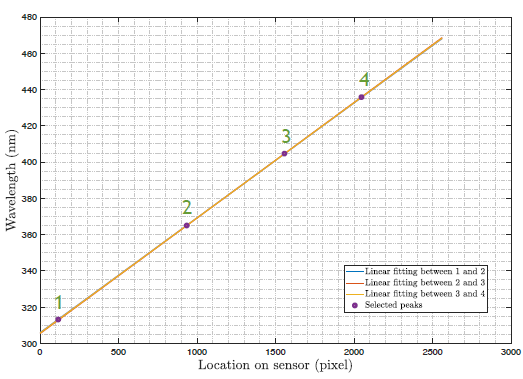
lamp in the 253-580 nm range was used to linearly fit the of this function will also be used following experiments
peaks to their expected wavelengths, as shown in Fig.14. to obtain an estimation of electron densities [Cru12].
For each spectral image taken, all identifiable spectral 4 104
lines were used to perform independent linear fittings
(Fig.15) and cross-compare the pixel location to wave- 3.5
length correspondance obtained. The fitted wavelengths 3
axis is then used to find the instrument line shape function 2.5
(ILS).
20 105 500 1000 1500 2000 2500 1.5
2.2
4 1
20.5
1.8
0
350 355 360 365 370 375 380 385
1.61.4 Figure 16. ILS fitting using the square root of a Voigt
1.2 3 function
2
1 As seen in Fig.16, the ILS obtained is asymmetric, which
0.8 1 could be due to slight misalignment of the optics inside
the spectrometer, or of the light source in front of the0.6 300 320 340 360 380 400 420 440 460 480 slit itself. The full-width half-maximum Gaussian and
Lorentz coefficients from a square root of Voigt func-
tion fitting were found to be 1.3221 and 0.0476 nm reFigure 14. Pixel to Wavelength Calibration - Sample set spectively. EAST experiments performed using the same
from mercury lamp emission slit width of 100 µm and same grating of 150 gr.mm−1
had ILS with similar Gaussian and Lorentz coefficients
480 of 1.3299 and 0.0294 nm [AAts].460
4.2. Spatial calibration 440 4
4.2.1. Resolution of optics
420 3
400 35380 2 30
360
340 25
320 120
300
0 500 1000 1500 2000 2500 300015

Figure 15. Pixel to Wavelength Calibration - Linear Fit.
Numbers corresponds to the peaks shown in Fig.14.
104.1.2. Spectral Instrument Line Shape (ILS) 5
An accurate characterisation of the ILS is essential to be
able to both model and quantify physical effects affecting -0.050 -0.04 -0.03 -0.02 -0.01 0 0.01 0.02 0.03 0.04 0.05
the spectral line shape, such as pressure broadening or
Stark effect, dominant at the speeds of interest [Cru12].
Using the most intense spectral lines on each calibration Figure 17. Approximated optical resolution function, usimage recorded, the square root of a Voigt function is fit ing the signal received by the collimating mirror from a
to the signal. It was empirically found that these were point source at the center-line of the tunnel.Using the ray-tracing simulation results, the signal re- to its derivative, is shown in Fig.20. If the optical system
ceived at the position of the collimating mirror was ob- provided perfect imaging, this function would correspond
tained to measure the angle between the edge rays ema- to a Dirac impulse function located at the sensor’s centernating from a point source on the tunnel’s axis. The op- line.
tical resolution function in Fig.17 was approximated by
a triangle of the same angle, as the light from the point
source captured by the camera is described by the vol- 1800059.06 59.11 59.16 59.2 59.25 59.3 59.34 59.39 59.44 59.48 59.53
ume of the cone contained within the edge rays [Cru14]. 16000
This approximation confirms the effectiveness of the telecentric system to keep this volume and therefore the as- 14000
sociated spatial smearing small. As shown in Fig.17, 12000
the angle of the cone is 43% smaller than the one from
the EAST collection optic system presented in [Cru14] 10000y
which recorded VUV spectra with satisfying spatial res- 8000
olution, which suggests less spatial merging of emission 6000
characteristics.4000
2000
4.2.2. Resolution of collection optics and CCD array 0
8.22 8.24 8.26 8.28 8.3 8.32 8.34
By simulating 2E6 light rays emanating from the tun- Figure 19. Approximated Spatial Edge Spread Function
nel’s axis, clustered to form a square light source of
known dimension and location, a sharp edge was simulated (Fig.18) and used to obtain an approximation of the
resolution function and estimate the spatial smearing of The LSF curve was found to be slightly shifted from the
the optics. center of the camera’s sensor. It can be seen on Fig.18
that the image is shifted to the left by a few pixels, and
suffers from some astigmatism deforming its shape from
a perfect square. It can also be observed that the intensity
tends to be higher towards the right, which could also be
observed to a lesser degree in the simulation in Fig.11.
This could be due to the lack of symmetry of the optical
system creating a higher ray concentration to one side,
which generates an asymmetric and slightly shifted spa-
tial smearing function.59.11105 59.16 59.2 59.25 59.3 59.34 59.39
1816
14
12
10
y
8
6

Figure 18. Light received by the virtual sensor from the
sharp edge simulation. Location of the middle pixel of 4
the sensor is shown. 20
8.22 8.24 8.26 8.28 8.3 8.32 8.34The camera sensor was modelled by positioning a virtual
screen of equal dimension and resolution at the spectrom- Figure 20. Approximated Spatial Line Spread Function
eter slit location. The outer edge of the emitting square
was positioned in the middle of the field of view, ideally creating a step in intensity right in the middle of the
camera’s sensor. The intensity of each column of pix- Some additional smearing may also be introduced by the
els, representing spatial location along the window, was optics contained in the spectrometer, which also combinned to obtain the edge spread function (ESF) shown prises a cylindrical mirror to correct for the astigmatism
in Fig.19. The line spread function (LSF), corresponding measured by the manufacturer.4.2.3. Shock motion 4.3.2. Raw signal corrections
106The loss of resolution due to the shock motion during 15
the camera shuttering was approximated by defining the
smearing length as the product of the shock velocity and
the camera’s gating time. The corresponding spatial resolution function was modelled as a square wave of equiv- 10
alent width. An example can be seen in Fig.21.5
4.2.4. Total spatial smearing function
The functions presented in section 4.2 were convolved,
0
and the resulting spatial smearing function applied to the 120 130 140 150 160 170 180
radiance simulations as shown graphically in Fig.21.
Figure 22. Comparison of raw and corrected signalsA picture of the background noise for the same spec-
trometer and camera parameters was recorded at the same
level of vacuum, and subtracted from the calibration sig-
nal. As the deuterium lamp underfills the spectrometer
slit which has the same F# as the rest of the optics, the
calibration signal was multiplied by the ratio of the spec-
trometer and lamp solid angles Ωspectrometer to compen- Ωlamp
sate for the extra signal which will be collected during a
shot. Finally, the signal was multiplied by the reflectiv-
ity curve of the Al+MgF2 mirror coating for each mirror
used in order to simulate the optical loss through the fo-
cusing optics which are not present in the current state of
the set-up. The effects of these corrections can be seen in
Fig.22.4.3.3. Intensity fit
10-4

Figure 21. Spatial smearing function applied to all radi- 4
ation simulations3
4.3. Intensity calibration
2
Finally, an intensity calibration was performed using a
deuterium lamp (Hamamatsu L7292). The light source
and camera were mounted on the spectrometer, and the 1
120 130 140 150 160 170 180
system pumped down to 1.35E-5 mbar before recording
spectra and fitting it to the manufacturer’s spectral radiance curve.
Figure 23. Radiance per count calibration for each wave-
length4.3.1. Wavelength fit
The corrected signal was finally fitted using the expected
A linear wavelength fit was found to be insufficient to radiance curve from the deuterium lamp. The obtained
satisfyingly fit the signal, and was therefore refined by values of counts per spectral radiance as a function of
performing linear interpolations on smaller sets of pix- wavelength shown in Fig.23 can be used to convert the
els. Once the signal was fitted in wavelengths, corrections spectra to units of radiance.
could be applied.5. TEST CONDITION SELECTION
Table 3. Flow conditions simulated in view of the next
test campaign. Freestream mass fractions are assumed to
be 0.767 for N2 and 0.233 for O2.The smearing functions parameters obtained in Section Shot P∞(Pa) u∞(km.s−1) T∞(K)
4 were applied to the simulations presented in this sec- EAST 57-8 26.66 10.66 293
tion to create a more representative model of a non-ideal
Fire II 2.08 11.36 195
physical optical collection system.
Non-eq 6.66 11.38 293Shock-tube post-shock relaxation simulations were performed using Poshax3 [JG22], and the results of temperatures, pressures, and species number densities along
lines of sight perpendicular to the window’s test section used as an input for radiation simulations using
NASA’s code NEQAIR. These simulations aim at reproducing conditions from either experiments performed by 5.1. Poshax3 and Neqair Simulations
NASA in their Electric Arc Shock Tube (EAST) facility
which showed experimentally measurable levels of radiative emission in the VUV, data points from previous test5.1.1. EAST shotcampaigns performed in the Oxford T6 wind tunnel, or
re-entry points from the Fire II mission.
Three conditions with flow parameters shown in Table Experiments performed in EAST were simulated and
3 were selected for showing good trade-off between the compared to shots previously performed in T6. Shots
high level of radiance shown by simulation in the wave- highlighted by NASA for showing measurable spectral
length range of 120-200 nm, and the spatially large region radiance levels in the VUV range of the spectrum were
of non-equilibrium. It is therefore believed that these selected.
points will generate measurable data during experiments,
as the level of radiance intensity and the non-equilibrium
region are large enough to be respectively spectrally and
spatially resolved by the camera and the optical collection system. These data points are shown in the context
of the facility’s history and literature in Fig.24.103
102
EAST 57-8 (lower VUV)
221 Figure 25. Post-shock three-temperature variation from
101 simulation of the EAST shot 57-8 [AAts]
229Non-eq231230
Fire II
228 227 As seen on the temperature trace in Fig.25, shot 8
100
6 8 10 12 14 16 18 from the EAST test campaign 57 was found to give a
non-equilibrium region of about 5 mm length behind the
shock. Although short, this can be sufficiently resolvedFigure 24. Tests of interests in facility and context in by our optical system which has a spatial resolution of
literature. The T6 shots data is presented in [CDS+21, 0.047 mm per pixel.
HCG+]. EAST shots data can be found in [AAts].Figure 26. Radiance obtained from simulation of the
EAST shot 57-8 [AAts] Figure 28. Radiance obtained from simulation of the Fire
II mission re-entry pointThe spectral radiance shown in Figs.26 and 27
in the 120-200 nm range reaches a maximum of
1200 W.cm−2.Sr−1.µm−1 over this region, giving measurable radiance in the EAST facility which uses an optical system of similar resolution [GCGY09, Cru14]. The
next test campaign will therefore aim at recreating this
condition. Corresponding flow characteristics are shown
in Table 3.
This datapoint was however judged particularly inter-
esting because of the large non-equilibrium region it
presents. Figure 25 shows a length of 24.24 mm behind
the shock before temperatures start to plateau, which cor-
responds to a quarter of our available field of view. In this
case, temperatures seem to keep on rising slightly long
after the shock has passed, instead of completely plateau-
ing to a steady value. Corresponding flow conditions can
be found in Table 3.Figure 27. Spectral and cumulated radiance from simulation of the EAST shot 57-8 [AAts]
5.1.2. Fire II re-entry point
A simulation of a trajectory point from the Fire II mission, corresponding to t = 1634 s shown spectral radiance
levels lower than the first point selected in Section 5.1.1,
with a maximum of 430 W.cm−2.Sr−1.µm−1 at 120 nm Figure 29. Spectral and cumulated radiance from simuas shown in Figs.28 and 29. lation of the Fire II mission re-entry pointFigure 32. Radiance obtained from simulation a previous
T6 shotFigure 30. Post-shock three-temperature variation from
simulation of the Fire II mission re-entry point5.1.3. Non-equilibrium point
Finally, a data point from a previous test campaign performed in T6 was simulated. As shown in Figs.33 and 31,
temperature and radiance plateau shortly after the shock,
after just less than 10 mm. However, the spectral radiance profile shown in Fig.33 presents a few high peaks at
120, 131, 149.4 and 174.4 nm with spectral radiances as Figure 33. Spectral and cumulated radiance from simuhigh as 1000, 1026, 1056 and 1125 W.cm−2.Sr−1.µm−1 lation a previous T6 shot
respectively. This point was therefore selected as the radiance from this shot should be easily measurable. Corresponding flow conditions can be found in Table 3.6. CONCLUSION
A VUV spectroscopy system is currently in the final de-
sign stage to be mounted on the Oxford T6 Stalker steel
shock tube to perform emission spectroscopy. The col-
lection optics were designed as a telecentric system using
an optimisation code, and widely characterised through
ray-tracing simulations. The system in its current state
was calibrated in all three dimensions of wavelength,
space and radiance. A few experimental points of interest
for investigation of the non-equilibrium region have been
highlighted. These conditions of interest were simulated
using Poshax3 and NEQAIR to obtain predictive levels of
radiance in the VUV. Before the test campaign to come,
further study of absorbance and individual spectral lines
in these regions will be conducted through simulations,
as well as further characterisation of the system using the
optics to compare with simulations. Some phenomena
observed in previous test campaign in T6, such as slightFigure 31. Post-shock three-temperature variation from hydrogen contamination and underestimation of electron
simulation a previous T6 shot density will also be added to the simulation model.7. ACKNOWLEDGMENT [GCM21] A. B. Glenn, P. L. Collen, and
M. McGilvray. Experimental non-
equilibrium radiation measurements for
This research was funded by the UKRI Future Leaders low-earth orbit return. AIAA SCITECH
Fellowship scheme (grant number MR/T041269/1), and 2022 Forum, 2021.
we extend our gratitude to UKRI. For Open Access, the
[HCG+] Tobias Hermann, Peter Collen, Alexauthor has applied a CC BY public copyright licence to
Glenn, Tamara Sopek, Matthewany Author Accepted Manuscript (AAM) version arising
McGlivray, , and Luca di Mare. 9thfrom this submission.
International Workshop on Radiation of
High Temperature Gas.
[HLZ+16] T. Hermann, S. Lohle, F. Zander, H. Fulge,REFERENCES
and S. Fasoulas. Characterization of a reen-
[AAts] B. Cruden National Aeronautics try plasma wind-tunnel flow with vacuum-
and Space Administration. Elec- ultraviolet to near-infrared spectroscopy.
tric arc shock tube (east) test data. Journal of Thermophysics and Heat Trans-
https://data.nasa.gov/docs/datasets/. fer, 2016.
[BJ14] A. M. Brandis and C. O Johnston. Charac- [JG22] P. A. Jacobs and R. J. Gollan. Eilmer 4.0
terization of stagnation-point heat flux for flow simulation program. 2022.
earth entry. 45th AIAA Plasmadynamics [JMG+13] C. O. Johnston, A. Mazaheri, P. Gnoffo,
and Lasers Conference, 2014. B. Kleb, and D. Bose. Radiative heating
[BJC16] A. M. Brandis, C. O Johnston, and B.A uncertainty for hyperbolic earth entry, part
Cruden. Investigation of nonequilibrium 1: Flight simulation modeling and uncer-
radiation for mars entry. 46th AIAA Ther- tainty. Journal of Spacecraft and Rockets,
mophysics Conference, 2016. 50, 2013.
[CDM19a] P. Collen, L. Doherty, and M. McGilvray. [Jr.19] J. D. Anderson Jr. Hypersonic and high-
Measurements of radiating hypervelocity temperature gas dynamics, third edition.
air shock layers in the t6 free-piston driven 2019.
shock tube. International Conference on
[MDM+15] M. McGilvray, L.J. Doherty, R. G Morgan, Flight Vehicles, Aerothermodynamics and
D. Gildfind, P. Jacobs, and P. Ireland. T6:
Re-Entry Missions and Engineering, 2019.
The oxford university stalker tunnel. 20th
[CDM+19b] P. Collen, L. Doherty, M. McGilvray, AIAA International Space Planes and Hy-
I. Naved, R. T. Penty Geraets, T. A. Her- personic Systems and Technologies Con-
mann, R. G Morgan, and D. Gildfind. ference, 2015.
Commissioning of the t6 stalker tunnel.
[SCG+] Joseph Steer, Peter Collen, Alex Glenn, AIAA Scitech 2019 Forum, 2019.
Tamara Sopek, Luke Doherty Christopher
[CDS+21] Peter Collen, Luke J. Doherty, Suria D. Hambidge and, Matthew McGilvray, Ste-
Subiah, Tamara Sopek, Ingo Jahn, David fan Loehle, , and Louis Walpot. 9th In-
Gildfind, Rowland Penty Geraets, Rowan ternational Workshop on Radiation of High
Gollan, Christopher Hambidge, Richard Temperature Gas.
Morgan, and Matthew McGilvray. De-
velopment and commissioning of the t6 [Yur02] Yury. Optometrika.
stalker tunnel. Experiments in Fluids, (https://github.com/caiuspetronius/Optometrika),2021. GitHub., 2002.
[Cru12] B. A. Cruden. Electron density measure-
ment in reentry shocks for lunar return.
Journal of Thermophysics and Heat Trans-
fer, 26, 2012.
[Cru14] B. A. Cruden. Absolute radiation measure-
ments in earth and mars entry conditions.
2014.
[GCGY09] R. B. Greenberg, B. A. Cruden, J. H. Grin-
stead, and D. Yeung. Collection optics
for imaging spectroscopy of an electric arc
shock tube. Novel Optical Systems Design
and Optimization XII, 74290H, 2009.
[GCJ+] Alex B. Glenn, Peter L. Collen, Carolyn M.
Jacobs, Christophe O. Laux, and Matthew
McGilvray. 9th International Workshop on
Radiation of High Temperature Gas.Additional extracted image crops
The following extracted crops could not be confidently mapped to a numbered caption and are included for completeness.


Speaker: Maïlys Buquet -
22
An investigation into the role of the chemical models in the enthalpy rebuilding procedure of Inductively Coupled Plasma facilities through sample-based Sobol’ indices
Ground testing has always been essential for aerospace development. As an example, they are a key component in the design process and qualification of thermal protection materials for re-entry systems. They also have a crucial role to tackle the problem of space debris for which the end-of-life disposal through aerothermal demise in atmospheric entry is largely promoted. In such context, plasma wind tunnels are required for the validation of the design-for-demise (D4D) tools. Their testing conditions (e.g., free-stream enthalpy) must be accurately known to offer flight-relevant test conditions for material testing and precise database generation. Unfortunately, they cannot be directly measured and must rely on empirical formulas or rebuilding procedures. These methodologies couple numerical models and experimental data increasing the total uncertainty of the envisaged quantities due to inaccuracies in the selected models and errors in the measurement chain.
The overall objective of this work is to assess the impact of measurement uncertainties and some model assumptions on the enthalpy inference of Inductively Coupled Plasma facilities through a Bayesian formulation. We have recently presented three different enthalpy rebuilding procedures with application to the VKI’s Plasmatron at the FAR conference held in Heilbronn that is, the ASTM method, the standard VKI rebuilding procedure, and a stochastic approach based on the Bayes theorem. While the former employs an empirical formulation of the enthalpy, function of heat flux and dynamic pressure measurements only, the VKI procedure includes the effect of the catalysis phenomena described by the catalytic coefficient, $\gamma$, assumed known from the literature. Conversely to deterministic approaches resulting in a point-estimate, the stochastic method provides a full probability distribution of the inferred quantity due to measurements’ uncertainties and models’ inaccuracies. A normal distribution with a 2$\sigma$ confidence level set to 10% uncertainty range for the experimental data and a (log) uniform distribution for $\gamma$ was considered based on the conclusions of previous works. This paper aims to extend the previous results by computing the actual uncertainties of the experimental data, and to investigate other models’ assumptions hereafter presented.
The Bayesian formulation requires the solution of the forward problem thousands of times to correctly predict the statistics of the quantity of interest. The forward problem is based on the heat flux computation that is then compared with the experimental counterpart through the evaluation of the likelihood function. The heat flux computation is performed with two CFD codes that are, the ICP solver and the Boundary Layer (BL) code. The former simulates the plasma jet in the Plasmatron chamber under the LTE assumption. The ICP reference conditions are the mass flow rate supplied to the torch, $\dot{m}$, the static pressure of chamber, $p_s$, and the effective power supplied to the plasma by induction. For low subsonic, low Mach number test conditions, $\dot{m}$ and $p_s$ are considered constant, as verified by the results of numerical simulations and dynamic pressure measurements, and therefore set equal to the experimental values. As far as $P^{eff}_{el}$ is concerned, it is exact value is still unknown and efforts are underway to overcome the problem. Today, a power efficiency $ \eta = \frac{P^{eff}_{el}}{P^{eff}_{el}}$ = 50 % is accounted for with $P_{el}$ the electrical power supplied by the VKI’s Plasmatron generator to the coil. The ICP provides the boundary layer edge quantities, in terms of five non-dimensional parameters, to the BL code that solves the flow around the testing sample, with catalytic coefficient $\gamma$, under chemical non-equilibrium conditions. One of the outputs of the BL code is the heat flux at the wall.
This paper proposes to investigate the assumptions of $\eta$ = 50% and the definition of the non-dimensional parameters in enthalpy inference. For instance, the fifth parameter is defined as the ratio of the normal component of the velocity with respect to the probe at the boundary layer edge dimensionalized by the free-stream velocity. However, the choice of the free stream point may differ among the authors (e.g., half at the distance between the probe and the torch exit section or the point where the velocity gradient of the tangential component along the tangential direction has an inflection point, etc). Preliminary studies have shown a negligible effect on the heat flux estimation, but further investigations are necessary to better assess the role in the inference problem. Furthermore, the chemical non-equilibrium in the boundary layer employs chemical models such as Park’s Gupta’s or Dunn-Kang’s, that provide the coefficients of the Arrhenius law modeling the formation/deprecation of the species which may significantly impact the heat flux computation. Such coefficients are affected by significant inaccuracies being calibrated more than 20 years ago and validated with experimental data available at that time. We, therefore, propose to extend the stochastic approach to study the Park’s coefficients uncertainties in the enthalpy estimation.
Speaker: Enrico Anfuso (Vrije Universiteit Brussels)
-
20
-
-
-
FacilitiesConvener: Brett Cruden (AMA Inc/NASA Ames)
-
23
Plasma Ball Formation: an experimental technique to test radiative models in non-equilibrium plasmas
Background
In hypersonic flights, the energy transfer between the atmosphere and the vehicle depends greatly on gas kinetics, in particular on nonequilibrium vibrational kinetics as well as on dissociation and recombination processes which are similar in many aspects to those met in electric discharges in gases [1]. As mentioned in [1], “the main difference is that in the latter case the vibrational quanta are primarily pumped by electrons while during reentry they are pumped by recombination processes...” This difference may however be suppressed in our setup, thanks to the plasma ball formation (PBF), an acoustic plasma confinement mode we have recently discovered during the development of a pulsed sulfur plasma lamp [2], also observed by a team at UCLA [3]. Indeed, the molecular dissociation is then governed by the pure vibrational mechanisms [2], i.e. by the collisions between vibrationally excited molecules, rather than by electron impacts [4], p. 228. Another similarity between hypersonic plasmas and the sulfur plasma in our device is the radiative energy transfer that arises from the relaxation of excited electronic states of molecules formed in recombination processes, resulting in optical emission spectrum (OES) that does not follow the Planck’s law. Moreover, in our device the chemistry is dominated by two-atom dissociation-recombination processes (S2), as in a hypersonic plasma of Earth’s atmosphere (N2, O2). In both cases, the chemical kinetics are determined by the excitation-relaxation of vibrational states.
The objective here is to study the non-equilibrium vibrational aspects involved in PBF. This phenomenon is obtained by pulsing the input microwave power with a short duty cycle, at a repetition rate of the order of 30 kHz, providing spherically symmetric compression-expansion cycles for the plasma. During PBF, the plasma is confined at the center of the spherical bulb, extending to half radius. From the measurements of the acoustic resonance frequency, the average sound velocity as well as the average pressure and temperature inside the bulb were found to be 0.60 km/s, 0.52 MPa and 2.2 kK, thanks to a one-node-lumped model [2]. The acoustic waves are necessary for the PBF to take place. However, the exact force balance during the confinement is not yet completely understood, a crucial question this study opens a way to answer by analyzing digital photographs as well as OES. The final goal of this project is to provide physics basis for the design of an experimental device to ease the costly calculations [5, 6] required to simulate atmospheric reentry in hypersonic shockwave conditions. For instance, the bulk viscosity is still a topic of investigation as this property of nonequilibrium gases is extremely difficult to measure [7] and is therefore often neglected, as in [8] for instance. Yet, it introduces a dispersion effect resulting from velocity divergence and in hypersonic reentry it can have an influence on the shock wave structure [9, 10]. This paper shows there are reasons to think that the bulk viscosity plays an important role in the PBF. Moreover, the possibility of it becoming negative does not seem to be considered in the western aerospace community as we only found publications from Russia mentioning “Negative bulk viscosity” in a literature study. Evidence for this sign change, however, could be obtained from the amplification of sound waves that occurs during PBF, as shown in this publication.
Methodology
In this work, we concentrate in two experimental observations of the PBF as follows:
1) Shape analysis for understanding the convective cells and heat transfer inside the bulb.
Digital photographs have been analyzed in order to reveal the exact shape of the plasma ball. The camera was a Panasonic DMC-FZ8 placed behind a green solder filter. The contrast between the plasma ball and the background was increased by digital treatment. The plasma ellipticity was determined by manually fitting an ellipsoid in the high contrast image.
2) Spectral analysis for estimating the vibrational temperature of the S2 molecules.
The OES, emanating from the plasma, was recorded with a CAS 140CT array spectrometer in the wavelength range of 300–1100 nm. The average photon energy was integrated from the spectra. This value was then used as the LHS of the equation (9) of [11] in order to find the corresponding values of the vibrational quantum numbers and the energies of the excited and ground electronic states of the S2 plasma molecules, taking into account their anharmonicity. From the Frank-Condon factors given in [11], the most and second most likely transitions were associated with the peaks in the OES for a discussion of vibrational pumping [12, 13] and its role in the PBF phenomenon. Particular attention is paid to the effect on sound velocity in view of the application to modeling hypersonic plasmas.
Results
The plasma ellipticity was found to be close to one. No expected concavity was observed at the bottom of the ball, due to possible inward mass flow from the peripheral zone to the plasma, like seen in flames. A dissipative structure composed of two convective cells could explain this unexpected observation, as we show in this publication. A non-equilibrium thermodynamic modeling is proposed for the interpretation of this dissipative structure, based on the vibrational excitation gap between the plasma and the surrounding gas. Our analysis of the OES shows that the S2 ground state mean vibrational energy, for a plasma in the spherical mode (PBF), is 1.97 eV, whereas it is at 1.81 eV in the case no PBF, consistent with the observed redshift of the emission peak. This result, the increase of the sum of vibrational quanta in the plasma, suggests that the PBF enhances the vibrational pumping mechanism. The cause of this effect could be related to the sound dissipation due to the bulk viscosity.
Conclusion
This additional vibrational pumping could explain the observed features according to the presented non-equilibrium thermodynamic model. Complementary experimental investigations should make it possible to measure the bulk viscosity. The plasma translational and vibrational temperatures are of particular interest because, being modifiable thanks to the input power control parameters (mean value & modulation), it is possible to study the effect of varying plasma state. Thus, in addition to providing an experimental technique for testing radiative models in non-equilibrium plasma, PBF could open a way to measure the bulk viscosity under controlled conditions, in addition to the sound velocity, so offering an opportunity to improve the models used in numerical simulations of hypersonic flows.[1] M. Capitelli, C. M. Ferreira, B. F. Gordiets, A. I. Osipov, "Plasma Kinetics in Atmospheric Gases", Springer-Verlag, 2000, p. 3
[2] G. Courret, P. Nikkola, S. Wasterlain, O. Gudozhnik, M. Girardin, J. Braun, S. Gavin, M. Croci, and P. W. Egolf, "On the plasma confinement by acoustic resonance", The European Physical Journal D, 71(8):1–24, 2017
[3] J. P. Koulakis, S. Pree, A. L.F. Thornton, and S. Putterman, "Trapping of plasma enabled by pycnoclinic acoustic force", Physical Review E, 98(4):043103, 2018
[4] M. Capitelli et al., Fundamental Aspects of Plasma, "Chemical Physics, Kinetics", Springer, 2016.
[5] M. Tuttafesta, G. Pascazio, Gianpiero Colonna, "Multi-GPU unsteady 2D flow simulation coupled with a state-to-state chemical kinetics", Computer Physics Communications, 207 (2016) 243–257.
[6] G. Colonna, F. Bonelli, and G. Pascazio, "Impact of fundamental molecular kinetics on macroscopic properties of high-enthalpy flows: The case of hypersonic atmospheric entry", Phys. Rev. Fluids 4, 033404 – Published 29 March 2019.
[7] S. Taniguchi, T. Arima, T. Ruggeri, and M. Sugiyama. "Shock wave structure in rarefied polyatomic gases with large relaxation time for the dynamic pressure", In Journal of Physics: Conference Series, volume 1035, page 012009. IOP Publishing, 2018
[8] F. C. Moreira, W. R. Wolf, and J. L. F. Azevedo. "Thermal analysis of hypersonic flows of carbon dioxide and air in thermodynamic non-equilibrium," International Journal of Heat and Mass Transfer, 165:120670, 2021.
[9] V. S. Galkin and S.V. Rusakov. "On the theory of bulk viscosity and relaxation pressure", Journal of applied mathematics and mechanics, 69(6):943–954, 2005.
[10] S. Kosuge and K. Aoki. "Shock-wave structure for a polyatomic gas with large bulk viscosity", Physical Review Fluids, 3(2):023401, 2018.
[11] D. A. Peterson and L. A. Schlie. "Stable pure sulfur discharges and associated spectra", The Journal of Chemical Physics 73(4): 1551-1566, 1980.
[12] C. E. Treanor, J. W. Rich, and R. G. Rehm, "Vibrational Relaxation of Anharmonic Oscillators with Exchange-Dominated Collisions", Journal of Chemical Physics, 48(4), 1968.
[13] M. A. Rydalevskaya and Y. N. Voroshilova, "Transport Processes and Sound Velocity in Vibrationally Non-Equilibrium Gas of Anharmonic Oscillators", AIP Conference Proceedings, 1959(1), 2018.Speaker: Gilles COURRET (HES-SO) -
24
Temperature and electron number density measurements in the vki plasmatron ICP torch
The VKI Plasmatron facility is the world’s largest Inductively Coupled Plasma (ICP) torch, providing a chemically pure plasma flow for material response studies in atmospheric entry conditions.
This paper presents the experimental investigation of the freestream plasma flow by means of optical emission spectroscopy in the UV to NIR wavelength region. We used a mixture of synthetic air and hydrogen (77.9% N2, 20.1% O2 and 2% H2), with the aim of providing sufficient line strength of the Balmer beta line of the hydrogen atom for diagnostic purposes. The gas phase radiative signature of dominant atomic and molecular species is observed using a high resolution spectrograph, combined with a two-dimensional intensified CCD array. From the rebuilding of local emission intensities, obtained through Abel inversion, radial temperature profiles are determined under the assumption of Local Thermodynamic Equilibrium (LTE). The procedure is based either on fitting the experimental spectra with a line-by-line code (NEQAIR) or by analytical results assuming a Boltzmann distribution.Experimental results
LTE temperature profiles, measured from the absolute line intensities of H, O and N, agreed on a consistent trend. Boltzmann temperature profiles from oxygen lines also agreed with the LTE temperatures within the uncertainty bounds. Electron number density was measured from the Stark broadening of the Balmer beta line of hydrogen at 486.1nm, showing consistent overlap to the profile computed from the LTE temperature of the same line, under the assumption of chemical equilibrium. Synthetic spectra were computed with NEQAIR and compared to the measured ones over the whole range. Although the peaks were well represented, a residual baseline prevented good matching of the weaker parts of the spectra. A two parameters spectral fitting, including an LTE temperature and a uniform baseline, provided temperature profiles which agreed with the LTE temperatures within the uncertainty bounds.
Conclusions and future work
Overall, a local thermodynamic equilibrium model seems to provide an accurate description of the thermodynamic state of the plasma jet for the condition studied in this work. The model assumptions are corroborated by the consistent temperature profiles from different atomic line intensities, agreement with Boltzmann plot temperatures and electron number density measurements. LTE synthetic spectra also provide a good representation of the local emission intensities at different radial positions. Further investigation should be devoted to the understanding of the residual baseline effect. Possible explanations could be related to the uncertainties in the higher quantum number vibrational states, continuum radiation effects or to the presence of stray light. More precise baseline subtraction will also be performed on the Hβ line, based on measurements of synthetic air spectra.Speaker: Mr Andrea Fagnani (von Karman Institute for Fluid Dynamics) -
25
Ultra-Highspeed Optical Emission Spectroscopy System for Hypersonic Impulse Test Facilities
Abstract
With the advancement of technology comes opportunities to review current tools and methods to see how they can be improved. Optical emissions spectroscopy (OES) is a vital tool used on many facilities due to its non-intrusive nature. It is especially useful on hypersonic impulse test facilities such as shock tubes and expansion tubes as it allows for the chemical composition of the test flow to be determined. Limitations on hardware have restricted the amount of data that can be recorded during tests due to short test times at these facilities. To increase the number of spectral frames taken by an OES system the exposure time must be shortened, leading to the possibility of the OES system not detecting low intensity emissions. To circumvent this issue an image intensifier can be placed in front of the camera. This project aims to create an ultra-highspeed OES system to allow for greater understanding of non-equilibrium flows like those encountered upon entry into planetary atmospheres.Optical Emissions Spectroscopy System
The ultra-high speed emission spectroscopy system configuration to be developed in this project consists of a spectrometer with its output connected to a HiCATT 25 intensifier coupled with a V2012 Phantom camera. To ensure that the spectrometer exit focuses on the intensifier sensor, a diverging lens with a focal length of f=-100 mm was placed in an interface between the spectrometer and intensifier. The HiCATT 25 intensifier can increase sample rates up to 300 kHz or up to 2.5 MHz in bursts when synced with the Phantom camera.The system will be utilised on hypersonic impulse tests focusing on Mars return conditions and giant planet atmosphere entry conditions to test the initial capabilities of the OES system. The main capability of the system is a frame rate of 100 kHz allowing for 10 frames of spectral data to be collected on a single test on X2, as opposed to the current single frame of spectral data. This system will be primarily tested on UQ’s X2 expansion tube.
Using the designed ultra-highspeed OES system, the electron number density of the flow can be determined and how the gas species dissociate and change in the flow as temperature increases can be tracked. The OES system will be most effective at studying the non-equilibrium flow experienced during both experiments and actual entry into atmospheres. By better understanding these non-equilibrium flow conditions of planetary atmospheres the unknowns and uncertainties would be reduced, increasing the likelihood of a successful mission. This would allow for better planning for future missions to and from planets in our solar system which is crucial for space travel. The system is currently being tested on the well-known atmospheric composition of Earth, where entry conditions from a Mars return mission will be simulated.
The HiCATT 25 image intensifier is capable of exposures as short as 3 ns. The HiCATT 25 intensifies light using two photocathodes with a diameter of 25 mm at its inlet which converts incoming photons to electrons. The photocathode material used for the HiCATT in the system is gallium arsenide phosphide (GaAsP). The efficiency of the conversion for each wavelength is defined by the quantum efficiency of the photocathode material. The specific HiCATT 25 has a 10\% quantum efficiency (QE) at a wavelength of 300 nm which increases to a maximum QE of 50\% at 500 nm before decreasing back to 1\% QE at 750 nm. This makes the HiCATT 25 most effective between wavelengths in the visible spectrum between 300 nm and 700 nm. The output of the HiCATT contains a screen layer of phosphorescent material upon which when the converted electrons make contact, the screen emits light. The phosphor used in the systems HiCATT outlet screen is P46. P46 has a decay time of 0.500 µs to 10\% brightness and 2 µs to 1\% brightness. This is important to factor in when setting the frame rate, as too high of a frame rate could lead to severe overlap of the sensor leading to stacking of images on the intensifier’s screen. The gain setting on the HiCATT can be set between 400 and 900 volts. The output wavelength of the intensifier is primarily in the green area of the visible spectrum (550 nm). The HiCATT 25 can be synchronised to the V2012 Phantom by connecting the Phantoms strobe connection to the HiCATT’s controller box’s sync in connection.
Results
During initial testing the ultrahigh-speed spectroscopy system performed well. Changes to the system setup to capture data of different spectral wavelengths regions and at different frame rates were done in software, making these changes simple to make. The amount of data collected is a vast improvement to the single frame of spectral data that is typically recorded for tests on X2. It was previously thought that the flow reached steady state and did not change during the test; however, it was observed that the emission intensity does change over the course of the test.This was especially prominent in test x2s5098, the time-resolved intensity of emissions during these tests are seen in figure \ref{figure:9}. The emissions intensity rises after the OES system is triggered over roughly 30 µs before plateauing and dropping after the test gas has passed. This indicates that these types of high-speed spectroscopy systems are useful for observing dynamic changes in the flow, where previously it was not possible due to limitations in hardware and short test times on X2.
Speaker: Nathan Lu (The University of Queensland, Centre for Hypersonics) -
26
Infrared emission measurements of a recombining CO2 plasma
The study of the convective and radiative heat fluxes to the capsule surface during its atmospheric entry is critical for the design of the thermal protective system. For Mars entry scenarios, where CO2 represents 96% of the atmosphere, the radiative heat flux to the afterbody suffers from large uncertainties - up to 260%. The rapid hydrodynamic expansion of the plasma into the afterbody region results in rapid cooling, chemical recombination, and a departure from equilibrium. This chemical non-equilibrium and the associated radiation are still not accurately modeled, and our goal is to provide experimental data for model validation. Our experiments focus on a fundamental study of the recombination kinetics of CO2 plasmas.
The inductively coupled plasma torch at laboratoire EM2C was used to produce a CO2 plasma at atmospheric pressure. More details of the plasma torch facility can be found in Ref. [4] (see attachment). The CO2 plasma studied here exits the torch through a 1-cm diameter nozzle and is composed of 10% of CO2 and 90% of argon (argon required for stable operating conditions). The plasma is then passed through a water-cooled test-section of various lengths at high speed (~ 500 m/s) to force rapid cooling and chemical recombination. The IR spectra obtained by OES are calibrated in absolute intensity using a tungsten lamp traceable to NIST standards. The calibration procedure considered absorption from cold CO2 and H2O present in the optical path. The complete calibration procedure is described in [5] (see attachment). Figure 1 shows the calibrated and abel-inverted spectrum at the exit of the 35-cm test-section. This corresponds to the local emission at the center of the jet. Emission from both CO and CO2 is present. Several CO/CO2 spectra at different rotational and vibrational temperatures were calculated using the RADIS line-by-line radiative code, in conjunction with the HITEMP-2010 database. The best fit achieved is shown in red. The complete fitting procedure is described in [5] (see attachment).
A 0D chemical kinetic simulation was realized using the Cantera code in conjunction with the Park 1994 kinetics model. The temperature, as measured above using the CO molecular band, was converted into a time-dependent temperature profile, and put into Cantera which then calculates the evolution of the chemical composition. Figure 2 shows the evolution of CO in black and CO2 in red, the dashed lines represent the equilibrium. CO density prediction at 35 cm is in good agreement with our measurement at the exit of the 35-cm test-section. However, the CO2 density is underpredicted by a factor of about 10.
Speaker: Corentin Grimaldi (CentraleSupélec)
-
23
-
10:30
Coffee Break
-
Numerical Simulations
-
27
Coupling of Radiation and Spallation of Carbon Ablators in a Plasma Wind Tunnel
Ablative thermal protection systems (TPS) reduce the heat flux on a spacecraft during atmospheric entry through a number of effects. Modern materials consist of a porous carbon preform which is infiltrated with phenolic resin. During reentry, the resin inside the material pyrolyses which leads to the outflow of cold pyrolysis gases towards the surface and ultimately into the boundary layer and the flow field. This reduces the heat flux into the material. At the surface, the char remaining after the pyrolysis is decomposed through sublimation, oxidation and nitridation. This consumes heat and results in a recession of the ablator surface. In addition, the surface recession is increased through the mechanical erosion of the material, where solid particles are released from the surface. This undesired effect is summarized as spallation. Next to increasing the recession rate, spallation is also believed to alter the flow field and consequentially the radiation environment around the ablator. Yoshinaka et al. detected CN radiation in a supersonic plasma flow upstream of the shock, suggesting that the carbon was transported upstream trough spalled particles. Similar observations were made by Kihara et al. in a supersonic arc-heated flow. On the other hand, in similar ablation experiments by Raiche and Driver there was no significant emission of ablation products. However, in these experiments it is unclear, how much the severity of spallation differs between the tests. In this paper we present results from a test campaign where the number of spalled particles and the CN radiation and pyrolysis gas radiation in the flow field were measured simultaneously.
The test campaign was conducted at the plasma wind tunnel PWK1 at the Institute of Space Systems (IRS) at the University of Stuttgart and was targeted at the study of spallation of carbon preforms and carbon-phenolic ablators. The plasma condition was representative of the aerothermal loads that were experienced by the Hayabusa capsule at an altitude of 78 km during its reentry into Earth atmosphere. Before each test, the sample was placed outside of the flow. As soon as the desired plasma condition was set, the sample was moved to the center of the plasma flow, which defined the start time of the test. Each test had a duration of 30 s and ended with the shut-off of the plasma generator. The tested samples included the two carbon preforms Calcarb CBCF 18-2000 and Fiberform as well as the carbon-phenolic ablators Harlem and ZURAM. ZURAM is developed by the German Aerospace Center (DLR) and is produced using Calcarb as a carbon preform. The Harlem samples were produced at the IRS and both samples based on Calcarb as well as on Fiberform were tested.
The diagnostic setup allowed to study characteristic ablation performance parameters like the surface recession and surface temperature through photogrammetry and thermography respectively. The number of spalled particles were tracked via high-speed imaging. An Aryelle Echelle 150 spectrometer and a spectroscopic setup in Czerny-Turner configuration consisting of an Acton SpectraPro 2750 spectrometer coupled with an Andor Newton DU920N-OE CCD camera were used for measurements normal to the plasma flow.
The Acton SpectraPro spectrometer was located outside of the facility aiming at the sample. The plane-of-sight aligned with the entrance slit of the spectrometer was a horizontal slice in the flow field passing through the stagnation point. The measurement plane covered a width of approximately 66 mm along the stagnation line, comprising of 39 mm upstream of the sample and 27 mm on the sample. This was chosen so that, for the expected recession rate, the ablation layer was covered in the plane-of-sight for the whole duration
of the test. For a 300 lines per millimeter grating, the Andor camera can capture a wavelength range of 120 nm at a spectral resolution of 0.12 nm/px. The grating was centered at 380 nm aimed at studying the emission of CN in the flow field in the wavelength range of 320 nm to 440 nm.
The Echelle spectrometer was located on the opposite side of the test facility. Optical emission in the range from 250 nm to 880 nm were captured with this instrument. Its field of view was a circular spot with a diameter of 5mm recording the line-of-sight integrated radiance, that is aligned perpendicular to the flow and immediately upstream of the ablator surface. As the surface receded throughout the test, the measurement region moved upstream relative to the surface by up to 2 mm. The data allows to track the emission from pyrolysis products (e.g. H) over time and correlate it to the spallation frequency obtained through the high-speed images.
The final paper will contain an in-depth analysis of spallation rate, the radiation in the flow field and ablation performance characteristics like surface recession and temperature. Comparing the transient spallation rate with spatial and temporal profiles of CN emission will provide important contributions to the understanding of spallation mechanisms and the effect of spallation on the radiation in the flow field. This data can also serve as a validation for numerical models of spallation and the release of carbonaceous gases through spalled particles into the flow.Speaker: Felix Grigat (Institute of Space Systems, HEFDiG) -
28
Non-equilibrium modeling of inductively coupled plasma discharges
Background of the study : The windward side of a re-entry vehicle needs to be protected by a heat shield, made of advanced thermal protection materials (TPMs) to overcome the tremendous amount of heat loads during planetary entry. Because in-flight testing of new TPMs is prohibitively expensive, the extreme heat loads imposed on a thermal protection shield during hypersonic re-entry are reproduced by placing a sample of a TPM in a hot jet of plasma. An important class of plasma wind tunnels is the ICP (inductively coupled plasma) facility which offers a large volume of contamination-free plasma for a considerable amount of time as it does not require electrodes to generate the plasma. As a result, ICPs are often preferred for testing of thermal protection systems for re-entry vehicles.
An important aspect in the modeling of ICPs is the possible impact of Non-Local Thermodynamic Equilibrium (NLTE) effects. Most of the ICP studies reported in the literature assume that LTE conditions prevail. This assumption, however, breaks down at low pressures due to lowering of collisional rates among gas particles. As a matter of fact, temperature and chemical composition distributions in low pressure ICPs may show significant departure from equilibrium. Under these circumstances, the availability of accurate NLTE kinetics models is of paramount importance. This task may be achieved, in theory, by adopting a State-to-State (StS) kinetics formulation. In Sts models each internal energy state is treated as a separate pseudo-species, thus allowing for taking into account non-Boltzmann distributions. State-to-State models provide a superior description compared to conventional multi-temperature (MT) models, which are based on Boltzmann distributions. Most StS models assume that the rotational and vibrational energy levels of molecules are populated according to Boltzmann distributions at their own temperatures, $T_r$ and $T_v$, respectively. These models solve the master equation only for the electronic levels thereby implicitly assuming small departures from Boltzmann ro-vibrational distributions. However, although the assumption of rotational equilibrium may be safely assumed for ICP applications, the same assumption does not hold for the vibrational states of molecules such as $\mathrm{N}_2$ and $\mathrm{N}_2^+$ and may need a vibronic state-to-state treatment. Also, the radiative effects inside the ICP facilities have largely been neglected in most of the ICP studies. There are hardly any literatures presenting a systematic study of radiative effects in ICPs.
The present work demonstrates a high-fidelity multi-physics computational framework to study non-equilibrium and radiative phenomena in inductively coupled plasma discharges. This framework couples the plasma flow solver HEGEL (High fidElity tool for maGnEto-gas-dynamics simuLations) with an electro-magnetic solver FLUX (Finite-element soLver for Unsteady electromagnetix) for the magneto-hydrodynamic modeling of the ICP. The framework is further coupled with a radiative transport solver MURP (MUlti-fidelity Radiation Package) for taking into account the radiative effects while modeling the ICP discharge.
Methodology : The dynamics of NLTE gaseous plasmas treated in this work are governed by the species mass, global momentum and energy, and vibronic energy equations which have been implemented in a finite-volume solver HEGEL which uses the PLATO (PLAsma in Thermodynamic nOn-equilibrium) library for evaluation of plasma-related quantities (e.g. thermodynamic properties,
etc.). The electromagnetic field inside ICPs are governed by the set of Maxwell's equations which are solved in a mixed finite-element solver FLUX. Radiative heat transfer in the ICP facility is investigated using the numerical code MURP which is a finite-volume radiative heat transfer solver encompassing self-consistent non-Boltzmann spectral modules ranging from line-by-line to reduced-order approaches for the accurate and efficient description of plasma's spectral properties desired in the present work. All the above mentioned solvers have been developed at the Center for Hypersonics (CHESS) at University of Illinois.The governing equations for the plasma are coupled to those for the electromagnetic field via the Lorentz forces and Joule heating source terms. At the same time, the electric and magnetic field within the plasma are affected by the electrical conductivity of the latter. As a result, the two datasets (Lorentz forces and Joule heating for HEGEL, and electrical conductivity for FLUX) are passed at every fluid time-step to accurately capture the magneto-hydrodynamic phenomena occurring within an ICP. Similarily, HEGEL passes the species populations and the temperatures to MURP, while MURP feeds back the computed radiative losses as an energy source term to HEGEL. The required volume coupling between the above mentioned solvers is here realized using preCICE, an open source coupling library for partitioned multi-physics simulations. The electromagnetic equations are solved on a farfield mesh coinciding with the fluid mesh where only the torch section is meshed.
Results : Preliminary simulations have been performed using an electronic CR (collisional-radiative) model for Nitrogen [$e^-$, $N(1-7)$, $N_2(1-6)$, ${N_2}^+(1-5)$, $N^+$] plasma where we resolve the electronic-states by tightly coupling the electronic master equations with the conservation equations. The calculations have been done for 2D axi-symmetric torch configuration where cold Nitrogen gas is injected through a thin annular injector which gets heated by six parallel inductor coils. The operating conditions for the preliminary calculation are as followed : length of the torch 0.486m, torch radius 0.08m, pressure 1000 Pa, inductor power 50 KW, inductor frequency 0.45 MHz, inlet mass flow 6 g/s. The radial population distributions of the elctronic states of the chemical components at the mid-torch axial location show a significant amount of deviation from the populations obtained using Boltzmann distribution. The electronic state-to-state simulation results show the incapability of the conventional multi-temperature model in predicting the correct plasma physcis and suggest a need to do a more detailed study of ICPs using state-of-the-art CR models.
Conclusion : A high-fidelity multi-physics computational framework to study inductively coupled plasma discharges has been presented. Preliminary calculations using a multi-temperature model show a significant extent of non-equilibrium between the trans-rotational and the electron-electronic-vibrational modes at lower pressures. Furthermore, calculations performed using electronic CR model show a large deviation of the species populations from that obtained using Boltzmann distribution.
Future work will focus on using state-of-the-art vibronic CR models to simulate ICP discharges while taking into account the radiative effects via CFD-radiation coupling.Speaker: Mr Sanjeev Kumar (University of Illinois at Urbana-Champaign) -
29
Multi-Fidelity Modeling Framework for High-Temperature Gas Radiation
Introduction
During atmospheric entry flights, a substantial amount of radiative heat transfer occurs around surface of spacecraft and this affects the success of designed mission. The radiative heat transfer roughly depends on the fourth power of governing temperature which implies the accurate representation of it is one of the crucial components to design a thermal protection system (TPS).Depending on purposes, radiation analysis requires a wide range of fidelity in its numerical approach. For example, to identify stagnation point heating during an atmospheric entry flight, the radiative transfer equation (RTE) can be integrated using quasi-one-dimensional approximations, such as the tangent-slab and the spherical-cap methods, without significant loss of accuracy. However, to identify the radiative heat flux incident to the afterbody of a spacecraft by including the radiative cooling effect, a flow-radiation coupled approach to multi-dimensional spatial grid topology is inevitable. This aspect requires the development of a numerical framework that can manage the radiative heat transfer problem accurately and efficiently with variable levels of numerical fidelity.
To this end, this work aims to develop such an improved numerical toolbox for the high-temperature radiation analyses, currently targeting applications to hypersonic aerothermodynamics study. This abstract summarizes the modeling framework with selected results of applications.
Overview of Radiation Modeling Framework
In this work, a numerical toolbox MURP (MUlti-fidelity Radiation Package) has been developed to encapsulate various kinds of radiation analysis strategies required for high-temperature aerothermodynamics and astrophysical studies. It provides a flexible, efficient, and accurate numerical framework and this has been achieved by integrating the following three key components.a. Radiative Transport
The MURP supports integration of the radiative transfer equation (RTE) in one-, two-, and three-dimensional spatial grid topology that includes absorbing, emitting, and scattering non-gray medium. For one-dimensional cases, either SHOCK-TUBE or HEATING modes can be used. The former provides a spatially-resolved intensity profile that can be compared against shock-tube measured data. The latter can be used to compute wall-directed radiative heat flux based on the tangent-slab or spherical-cap methods to integrate the RTE.In multi-dimensional grid cases, the MURP supports two-dimensional, which includes axisymmetric, and three-dimensional RTE solvers. In these cases, the RTE is integrated by applying a finite-volume method (FVM) for both spatial and angular discretizations. The parallel I/O and distribution of the spatial mesh along the multiple processors are performed using a DMPlex object within the open-source library PETSc.
b. Spectral Property
A line-by-line (LBL) radiation module is employed to simulate detailed non-Boltzmann spectral properties at a given thermodynamic condition. This model includes bound-bound, bound-free, and free-free transitions from atomic, diatomic, and triatomic species. The non-Boltzmann electronic populations of upper and lower states of radiating species are computed based on the concept of non-Boltzmann correction factor. The radiation spectra emitted from species that can exist in the atmospheric compositions of Earth, Mars, Titan, Jupiter, and other kinds of ablative gaseous species from meteorite can be simulated to estimate spectral properties.Several kinds of reduced-order modeling strategies have been implemented in the MURP to reduce computational costs required for radiative heat transfer simulations. In this study, we demonstrate the multi-band opacity binning (MBOB) approach, which guarantees accuracy and efficiency for analyses of the diatomic molecular band systems.
c. Coupling
Coupling with other numerical codes, for example, the one between flow and radiation fields, is achieved through a volumetric coupling strategy. An open-source library preCICE is used to take care of the description of the coupler environment along with data exchange. A flow field solver HEGEL (High fidElity tool for maGnEto-gas-dynamics simuLations) developed at the University of Illinois is employed to obtain temperature and species number density distributions including thermochemical nonequilibrium effects. The MURP then determines the amount of radiative cooling by solving the RTE and feeds it back to the energy source term of HEGEL until the temperature field is frozen. The present study demonstrates a flow-radiation coupling for Titan atmospheric entry flight conditions.Applications to Hypersonic Non-Boltzmann Radiation Analysis
In the present study, electronic non-Boltzmann radiative heat transfer has been analyzed for Titan atmospheric entry flight conditions. First, we have studied features of electronic non-Boltzmann radiation by simulating the test campaigns measrued from NASA Ames EAST facility. The EAST shot 61-19 is considered benchmark data. The condition of shock is 0.1 Torr and 6.1 km/s with composition of 98% of $\text{N}_2$ and 2% of $\text{CH}_4$. From the present analysis, it has been found that not only the CN Violet and Red bands but also contributions from N and $\text{N}_2$ from the vacuum ultraviolet range are significantly affected by the radiative heat flux.Second, a Titan atmospheric entry flight trajectory(t=211 s) of Dragonfly is simulated in a flow-radiation coupled manner. This second part of the analysis is ongoing work and improvement of physical model's accuracy has been achieved by modifying chemical-kinetic parameters for the Titan mixture. Through sensitivity analyses, the most influential reaction processes are determined and calibrated against shock tube measurements. Then they are employed to investigate hypersonic flow and radiation fields around the Dragonfly entry capsule. The radiative cooling effect from Deep VUV to infrared is considered via efficient spectral data management by the MURP that identifies individual contributions from several different spectral ranges.
Concluding Remarks
In the present study, a multi-fidelity modeling framework for high-temperature gas radiation has been developed and applied to hypersonic atmospheric entry conditions. For accurate and efficient analyses of radiative heat transfer, spectral, radiative transport, and reduced-order modeling framework have been integrated into a single numerical code, MURP. Applications to hypersonic aerothermodynamics study for the Titan composition have been performed to demonstrate the capability of the MURP. This investigation first revealed the additional influential radiators in the high-energy spectral region in addition to the well-known strong radiator in the ultraviolet. Then the massive flow-radiation coupling analysis has been carried out and will be refined through future investigation to thoroughly identify the mechanism of radiative heat transfer in the Titan atmospheric entry conditions.Acknowledgement
This work has been supported under a NASA Space Technology Research Institute Award (ACCESS, grant number 80NSSC21K1117).Speaker: Sung Min Jo -
30
State to state dissociation rates of H2 by collision with H and He using the QCT method
The latest decadal planetary science survey recommended an orbiter and probe mission to Uranus [1]. Set to launch within the decade, now is an opportune moment to review kinetic data relevant for the design of this mission. The dissociation rates of molecular hydrogen are relevant for more accurate assessment of the convective heating experienced by an entry probe. Furthermore, in the last 20 years, several advancements on potential energy surfaces (PES) of systems relevant for giant planet entries have been published [2-5]. Simulations have estimated peak temperatures in the stagnation line to be around 27,000, 18,000, and 15,000 K for Jupiter [6] Saturn [7] and Uranus [7], respectively. Performing experiments at such high-temperatures is a challenging endeavor. The quasi-classical trajectory (QCT) method is useful to obtain kinetic data at such extreme temperatures [8] when quantum effects are negligible and as long as an accurate PES is available. The aim of this work is to propose state-to-state and global dissociation rates for molecular hydrogen by collisions with H and He. Additionally, a discussion on what remains to be accomplished for an updated global and state-to-state models for entry in Uranus is done.
[1] National Academies of Sciences, Engineering, and Medicine. 2022. Origins, Worlds, and Life: A Decadal Strategy for Planetary Science and Astrobiology 2023-2032. Washington, DC: The National Academies Press. doi.org/10.17226/26522 (2022)
[2] Mielke, S. L., Garrett, B. C. & Peterson, K. A. A hierarchical family of global analytic Born-Oppenheimer potential energy surfaces for the H+H2 reaction ranging in quality from double-zeta to the complete basis set limit. J. Chem. Phys. 116, 4142–4161 (2002).
[3] Mielke, S. L., Schwenke, D. W., Schatz, G. C., Garrett, B. C. & Peterson, K. A. Functional representation for the born-oppenheimer diagonal correction and born-huang adiabatic potential energy surfaces for isotopomers of H3. J. Phys. Chem. A 113, 4479–4488 (2009)
[4] Bakr, B. W., Smith, D. G. A. & Patkowski, K. Highly accurate potential energy surface for the He-H2 dimer. J. Chem. Phys. 139, (2013).
[5] Thibault, F. et al. Rovibrational line-shape parameters for H2 in He and new H2-He potential energy surface. J. Quant. Spectrosc. Radiat. Transf. 202, 308–320 (2017).
[6] Santos Fernandes, L., Lopez, B. & Lino Da Silva, M. Computational fluid radiative dynamics of the Galileo Jupiter entry. Phys. Fluids 31, (2019).
[7] Palmer, G., Prabhu, D. & Cruden, B. A. Aeroheating uncertainties in uranus and saturn entries by the Monte Carlo method. J. Spacecr. Rockets 51, 801–814 (2014).
[8] Jaffe, R. L., Schwenke, D. W. & Panesi, M. First Principles Calculation of Heavy Particle Rate Coefficients. Hypersonic Nonequilibrium Flows Fundam. Recent Adv. 103–158 (2015) doi:10.2514/5.9781624103292.0103.0158.Speaker: Dr Joao Vargas (King Abdullah University of Science and Technology, Physical Science and Engineering Division Mechanical Engineering Programme, Clean Combustion Research Center) -
31
Modelling of hot plumes with particles for improved launcher applications
Europe’s access to space today relies primarily on the Ariane 5 family of heavy lift launchers and the Vega launcher for small payloads. The successful development of these launchers depends on finding solutions in the critical and challenging areas of propulsion and aero-thermodynamics, which are the key elements of any launch vehicle. In the past, aerodynamic and aero-thermodynamic development work was almost exclusively based on the use of engineering and empirical methods. Today the use of Computational Fluid Dynamics (CFD) has matured to the point where it can provide valuable physics based input where in the past empirical or engineering methods required to strongly simplifying the physics involved. In addition, experimental testing is extremely expensive, time consuming and often it is impossible to simulate the real flight conditions. As a result the data obtained from these experiments is only partially useful and approximate methods need to be used to extrapolate these data to real flight conditions.
This work has been carried out in the Hot-Plume project and concerns the after body flow of launch vehicles also called the base flow region. This flow is characterized by large regions of unsteady separated flow induced by the abrupt changes in geometry of the vehicle. In this region hot gases from the nozzle exit mix with the cold flow coming around the launch vehicle leading to very complex aerodynamic phenomena which today are only poorly understood. As a result there exists a large area of uncertainty in launch vehicle design.
The NSMB solver developed by CFE-Engineering and University of Strasbourg can simulate turbulent hypersonic flow with chemical equilibrium and non-equilibrium modelling. Particle tracking coupled with radiation modelling has been implemented and validated on the VEGA launcher and applied to the simulation of a Solid Rocket Motor which was experimented at Vertical Test Section (VMK) of the DLR in Cologne. The coflow and the solid rocket motor injection plane were modelled using a total pressure and total temperature injection boundary condition. Two injection conditions were considered and the chemical compositions for these conditions were obtained using the NASA Chemical Equilibrium program CEA. Only the most important combustion species were considered and modelled with an equilibrium chemistry. The mixing of the hot plume exhaust gases with the cold coflow was modelled using a passive scalar.
The calculations showed that after the nozzle throat the larger particles remain closer to the symmetry axis than the smaller particles and have lower velocities. Particle velocities on the symmetry axis just downstream of the nozzle exit were found to be slightly higher than the measured particle velocities. The ho tplume experiments showed large unsteady separated flow regions just downstream of the nozzle exit. These large unsteady flow regions makes detailed comparisons difficult. Calculations with radiation showed that the WSSG model gives the most realistic incident radiation.Speaker: Yannick Hoarau (ICube, Université de Strasbourg)
-
27
-
13:00
Lunch
-
Visit Island
-
-
-
Missions
-
32
Characterization of MEDLI2 Radiometer Optics
I. Introduction
On February 18, 2021, the Mars 2020 Perseverance rover successfully entered the Martian atmosphere and landed safely on the surface. During entry, the Mars 2020 aeroshell was outfitted with a sensor suite, known as Mars Entry, Descent, and Landing Instrumentation 2 (MEDLI2), which measured pressures, in-depth temperatures, and surface heat fluxes at various points on the forebody heatshield and backshell [1]. The integrated sensor plug subsystem included two total heat flux sensors and one radiometer which was used to directly measure the radiative and convective heating on the backshell of the vehicle. The radiometer and one total heat flux sensor were located on the leeside shoulder of the backshell near the predicted peak radiative heating location while the other total heat flux sensor was located at a similar radial location on the windside shoulder of the backshell. A detailed analysis of the measurements recorded by these three sensors are reported by Miller et al. [2].
Prior to flight, an experimental campaign in the NASA Ames Research Center’s miniature arc jet (mARC) facility was performed in order to assess the possibility that ablation products from the forebody thermal protection system (TPS), convected downstream to the radiometer location, could deposit on the sapphire window of the radiometer and lead to a loss of the radiation signal [3]. These tests demonstrated signal losses of around 20 %, though questions remained about the applicability of the results to flight. In particular, while the expected heat loads on the forebody and aftbody TPS samples were nearly matched during the tests, the heating profile and length scales were very different from the flight conditions. Moreover, due to limitations on the mARC facility, the composition of the test gas contained significantly more nitrogen than the Martian atmosphere. Subsequent test campaigns performed in the NASA ARC’s Panel Test Facility arc jet demonstrated signal losses as high as 76 % [2]. Post-flight analysis of the measured total and radiative heat flux measurements suggest an actual signal loss of around 50 %, assuming the predicted convective and radiative heating rates are correct (total predicted heat flux varied by about 12 % from flight data) [2]. Based on these results, the largest uncertainty in the radiometer measurement is the change in the radiometer window transmissivity due to ablation product deposition, and more work is required to fully understand the flight radiometer measurements.
II. Methodology
In this work, we present a methodology for numerically predicting the MEDLI2 radiometer signal loss due to ablation product deposition, taking into account the actual time and length scales seen during the flight. The overall strategy is based on coupled ablation, radiation, and flow field solutions for the Mars 2020 vehicle over the Best Estimated Trajectory (BET). As a post-processing step, the film growth on the radiometer window is estimated using a detailed surface chemistry model, accounting for the key processes believed to be important for the change in transmissivity of the window. The predicted signal loss is then obtained from predicted irradiance on the vehicle surface at the radiometer location and the computed optical properties of the deposited film.
The coupled ablation, radiation, and flowfield solutions are obtained using the LAURA/HARA code [4], assuming two-temperature thermochemical nonequilibrium with the following 16 species: CO2, CO, N2, C, O, N, CN, O2, C2, C3, C5, H, H2, CH, C2H, and C2H2. The ablation rates are computed using locally 1D in-depth material response solutions based on the methodology of [5] for a PICA TPS, where the elemental composition of PICA is taken to be [C,H,O,N] = [0.403, 0.144, 0.435, 0.018] for the pyrolysis gas and 100 % carbon for the char. Only the forebody surface is modeled with an ablating boundary condition. The backshell is modelled using a fully catalytic wall, which is appropriate for SLA-561V insulation on the backshell.
The simulation framework for ablation product deposition compiled in this work is based on existing vapor deposition models developed for carbon nanotube growth [6, 7], silicon carbide coating [8, 9], petrochemistry [10], and the production of thin solid films for electronic devices [11, 12]. These diverse applications consider essentially the same fundamental process, although each with different chemical species. The model utilizes a detailed surface chemistry mechanism which describes the transition from ablation products in the gas phase to adsorbed surface species, and then the deposition of these surface species to the solid film. The total number of available surface sites is modeled as a conserved, material-dependent value, taken to be 1 × 10⁻⁹ mol/cm2 for the sapphire window as suggested by Zhluktov and Abe [13]. The surface site compositions are determined using a steady-state approach which allows for the determination of the deposition rate for the bulk phases.
Using the detailed surface chemistry model, the film deposition rates are integrated over the BET to yield an average film composition and thickness. The transmissivity of the film is then determined at each time point through exponentiation of the negative product of the film thickness, density, and absorption cross-section. Where possible, the spectral absorption cross-sections for each bulk phase are taken from relevant literature sources. For the dominant contribution of OH(b), we have utilized the cross-sections from Goullet et al. [14]. Once determined, the film transmissivity is then coupled with the measured transmissivity of the pristine window and the predicted incoming irradiance and integrated over the spectral range of the radiometer to determine the signal loss. The presentation will provide comparisons between this predicted signal loss with the rebuilt flight data and discuss how further improvements to the modeling framework could reduce uncertainties of future radiometer signal loss predictions.
References
[1] White,T.R., Mahzari,M., Miller,R.A., Tang,C.Y., Monk,J., Santos,J.A.B., Karlgaard,C.D., Alpert,H.S., Wright,H.S., and Kuhl, C., “Mars Entry Instrumentation Flight Data and Mars 2020 Entry Environments,” AIAA SciTech 2022 Forum, AIAA, 2022. https://doi.org/10.2514/6.2022-0011.
[2] Miller, R. A., Tang, C. Y., White, T. R., and Cruden, B. A., “MEDLI2: MISP Measured Aftbody Aerothermal Environments,” AIAA SciTech 2022 Forum, AIAA, 2022. https://doi.org/10.2514/6.2022-0551.
[3] Miller,R.A., Tang,C., McGlaughlin,M.S., White,T.R., Ho,T.S., MacDonald,M., and Cruden,B.A., “Characterizationofa Radiometer Window for Mars Aftbody Heating Including Ablation Product Deposition Using a Miniature Arc Jet,” 2018 Joint Thermophysics and Heat Transfer Conference, AIAA, 2018. https://doi.org/10.2514/6.2018-3590.
[4] Thompson, K., Hollis, B. R., Johnston, C. O., Kleb, B., Lessard, V., and Mazaheri, A., “LAURA Users Manual v5.6,” TM 2020-220566, NASA, 2020.
[5] Amar, A., Blackwell, B., and Edwards, J., “Development and Verification of a One-Dimensional Ablation Code Including Pyrolysis Gas Flow,” Journal of Thermophysics and Heat Transfer, Vol. 23, No. 1, 2009, pp. 59–71.
[6] Lysaght,A.C., and Chiu,W.K.S.,“Modeling of the Carbon Nanotube Chemical Vapor Deposition Process Using Methane and Acetylene,” Nanotechnology, Vol. 19, No. 165607, 2008.
[7] Ma,H., Pan,L., and Nakayama,Y.,“Modeling the Growth of Carbon Nanotubes Produced by Chemical Vapor Deposition,” Carbon, Vol. 49, 2011, pp. 854–861.
[8] Wang,R.,andMa,R.,“Kinetics of Halide Chemical Vapor Deposition of Silicon Carbide Film,”Journal of Crystal Growth, Vol. 308, 2007, pp. 189–197.
[9] Allendorf,M.D., and Kee,R.J.,“A Model of Silicon Carbide Chemical Vapor Deposition,”Journal of the Electrochemical Society, Vol. 138, 1991, pp. 841–852.
[10] Benzinger, W., Becker, A., and Huttinger, K. J., “Chemistry and Kinetics of Chemical Vapor Deposition of Pyrocarbon: I. Fundamentals of Kinetics and Chemical Reaction Engineering,” Carbon, Vol. 34, 1996, pp. 957–966.
[11] Coltrin,M.E.,Kee,R.J.,andMiller,J.A.,“A Mathematical Model of the Coupled Fluid Mechanics and Chemical Kinetics in a Chemical Vapor Deposition Reactor,” Solid State Science and Technology, Vol. 131, 1984, pp. 425–434.
[12] Wang,Y.,andPollard,R.,“An Approach for Modeling Surface Reaction Kinetics in Chemical Vapor Deposition Processes,” Journal of the Electrochemical Society, Vol. 142, 1995, pp. 1712–1725.
[13] Zhluktov,S.V.,andAbe,T.,“Viscous Shock-Layer Simulation of Air flow Past Ablating Blunt Body with Carbon Surface,” Journal of Thermophysics and Heat Transfer, Vol. 13, No. 1, 1999, pp. 50–59.
[14] Goullet,A.,Vallee,C.,Granier,A.,andTurban,G.,“Optical Spectroscopic Analyses of OH Incorporation into SiO2 Films Deposited from O2/Tetraethoxysilane,” Journal of Vacuum Science and Technology A: Surface and Films, Vol. 18, 2000, pp. 2452–2458.Speaker: Dr James B. Scoggins (NASA Langley Research Center) -
33
Mars Sample Return Flow Condition Design and Pitot Rake Testing in T6 Stalker Tunnel
Please find the abstract attached.
Speaker: Eric Won Keun Chang (University of Oxford) -
34
Summary of Dragonfly’s Aerothermal Design and DrEAM Instrumentation Suite
An overview of the Dragonfly aerothermal environments and simulations performed will be presented. Titan’s atmosphere predominantly consists of nitrogen (~98% by mole) with small amounts of methane (~2% by mole) and other trace gases. CN is a strong radiator and is found in nonequilibrium concentrations for Titan entry, and is of particular importance on the backshell, where radiation dominates the heat flux.
The presentation will discuss the simulation methodology and assumptions, as well as the margin process in determining the aerothermal environments for Dragonfly’s entry at Titan. A relatively new methodology, known as shock tube informed bias, based on experiments performed in the NASA Ames shock tube, EAST, are used for assessing design margins for Dragonfly’s radiative heating. Open questions regarding reconstruction of the Dragonfly entry, such as understanding the free-stream methane abundance will be discussed.
NASA Ames and Langley are partnering with DLR to propose a comprehensive instrumentation suite known as the Dragonfly Entry Aerosciences Measurements (DrEAM). Dragonfly will be the first competed mission to fly EDL instrumentation as part of NASA’s Engineering Science Investigation (ESI). DrEAM will provide key aerothermodynamic data and performance analysis for Dragonfly’s forebody and back-shell Thermal Protection System (TPS), and includes a DLR-provided Data Acquisition System (DAS).
The accurate modeling of nonequilibrium CN radiation has proven to be a difficult task. Prompted by the Huygens mis-sion, many experimental campaigns and analyses were per-formed to better understand the aerothermal environments experienced by the probe during Titan entry [1]. However, the Huygens probe carried no heatshield instrumentation. There-fore, the DrEAM instrumentation suite will significantly ad-vance the state-of-the-art not only by documenting the environment and performance of Dragonfly’s entry system but also by making key measurements in Titan’s atmosphere for the first time.
Aerodynamic and aerothermal environments and TPS response will be measured using sensors similar to the Mars Entry, Descent, and Landing Instrumentation 2 (MEDLI2) Instrumented Sensor Plug (MISP) and the COMbined Aero-thermal and Radiometer Sensor (COMARS) suite [2], with the latter supplied by DLR. For MEDLI2, MISP used em-bedded thermocouples (TCs) to directly measure in-depth temperature of the TPS at several locations, which can also be used to infer surface environments via inverse analysis. For DrEAM, the MISP style plugs will be known as Dragonfly Sensors for Aero-Thermal Reconstruction (DragSTR) plugs. Atmospheric density measurements and capsule aerodynamic data will be obtained through the onboard Inertial Measurement Unit (IMU), supplemented by hypersonic pressure transducers similar to those used by the MEDLI Mars Entry Atmospheric Data System (MEADS). The DrEAM pressure sensors will be known as Dragonfly Atmospheric Flight Transducers (DrAFT) On Schiaparelli, the COMARS suite included three total surface-mounted heat flux sensors, three pressure sensors, and one radiometer. For DrEAM, the COMARS package will be known as COmbined Sensor System for Titan Atmosphere (COSSTA).
References:
1. M. Wright et al. “A Code Calibration Study for Huygens Entry Aero-heating,” AIAA 2006.
2. A. Gülhan. et al. “Aerothermal Measurements from the ExoMars Schiaparelli Capsule Entry,” Journal of Spacecraft and Rockets, 2018.Speaker: Dr Aaron Brandis (NASA Ames Research Center)
-
32
-
10:30
Coffee Break
-
Missions
-
35
Experimental VUV Radiation Measurements for 13 and 14 kms Mars Return Re-entry Conditions in X2
This paper presents preliminary stagnation point VUV radiation measurements taken over a 25 mm diameter, 75 mm wide semicylindrical model at 13 and 14 km/s Mars return re-entry conditions using the X2 expansion tube facility at the University of Queensland.
Speaker: Samuel Lock (The University of Queensland) -
36
Mars 2020 backshell radiative heating measurement and shock tube verification
In February 2021, the Perseverance rover was brought to the surface of Mars by the Mars 2020 mission. A feature of the Mars 2020 capsule was instrumentation to measure its entry, descent and landing (EDL) with the so-called Mars EDL Instrumentation 2 (MEDLI2) [1]. The MEDLI2 introduced, among other things, backshell instrumentation, including a broadband radiometer. The radiometer was mounted on the leeside of the vehicle next to thermocouple plugs and a heat flux gauge. The data returned by the leeside MEDLI2 heat flux gauge is largely analogous to that measured by the COMARS gauge flown on the ExoMars Schiaparelli [2] entry in that it is measuring heat flux in an area that is entirely dominated by radiative heating. The COMARS measurement provided excellent validation of backshell radiative heating models for Mars entry, albeit at a limited number of points [3]. The MEDLI2 heat flux gauge measurement effectively confirmed the quality of the prediction, extended over the full trajectory, as will be presented in this paper. The MEDLI2 radiometer,however, was blocked by ablation products and suffered a loss of half of its signal. The second backshell heat flux gauge installed on the windside of the vehicle was also well predicted, although the heating had both radiative and convective contributions.
It was desired to reproduce the conditions of the Mars 2020 entry via ground testing in the Electric Arc Shock Tube (EAST) at NASA Ames. Tests to verify stagnation line heating were previously reported in EAST, confirming the presence of shock layer radiation as the major discrepancy in heatshield temperature modelling [4]. Therefore, tests for stagnation line heating were not repeated. Instead, the shock tube informed bias method [5, 6] was used to identify test conditions that may produce similarity to streamlines that pass around the backside of the vehicle and are responsible for the radiation observed at the two heat flux gauge locations. This method was used to identify a range of velocities and densities in the shock tube that are relevant for confirming the radiative environment encountered.
This paper reports the results obtained in the 10 cm diameter EAST shock tube, corresponding to later trajectory points at ambient pressures of 1.1-2.0 Torr and velocities from 1.2-3.5 km/s. The test series employed two primary diagnostics: emission spectroscopy and tunable diode laser absorption spectroscopy (TDLAS). The emission spectroscopy performed broadband measurements of the radiative emission of the 4.3 and 2.7 $\mu$m bands of CO2 at flight similar conditions, obtaining both spectral and spatial data corresponding to the relaxation behind the shock front. The TDLAS measured the absorption of several lines of CO and CO2 and obtains species number densities and temperatures as a function of time behind the shock front. This paper will review highlights of this test series and analyses of the emission and absorption data. While the datasets generally show good agreement with predictions, a few discrepancies and items for additional investigation are identified and will be discussed.
Speaker: Brett Cruden (AMA Inc/NASA Ames)
-
35
-
Ice Giants
-
37
Shock Radiation Tests for Ice Giant Entry Probes Including CH4 in the T6 Free-Piston Driven Wind Tunnel
The Ice Giants, Uranus and Neptune, represent a largely unexplored, interstitial class of planetary objects that fit between the Gas Giants and the smaller terrestrial worlds, such as Earth, in terms of their size and elemental composition and are therefore a missing link in our understanding of extrasolar planetary evolution. The scientific potential of a mission to the Ice Giants is well recognised and has been identified by NASA and ESA as a high priority on several occasions, most recently in the 2023 - 2032 Decadal Survey. The payload capacity of such a spacecraft is limited by the requirement for a bulky heat shield, made necessary by the paucity of ground test data for convective and radiative heat flux at proposed entry trajectories. This paper describes an experimental study of shock layer radiation via emission spectroscopy at Ice Giant entry conditions in the T6 free-piston driven wind tunnel. Shock waves of up to 18.9 km/s were driven through H/He mixtures containing up to 5% CH4 by mole. The magnitude of spectral radiance at the peak and in the immediate post-shock region appears to be strongly affected by the concentration of CH4 in the test gas. Thorough cleaning of the shock tube between each test was found to be very important for obtaining high quality data given the relatively low signal levels.
Speaker: Joseph Steer (University of Oxford)
-
37
-
13:00
Lunch
-
Ice Giants
-
38
Emission Spectroscopy of Plasma Flows for Ice Giant Entry
Uranus and Neptune are the only two exemplars of ice giant planets in the Solar System. This planetary class is currently not well understood, as the models for their interior structure cannot be fully explained by observations. As opposed to planets classified as gas giants, ice giants are mainly composed of volatile substances heavier than hydrogen and helium, called \textit{ices}, in their bulk. Such unique composition suggests that their formation is rather a rare event, which contrasts with their abundance in our galaxy. An exploration of Neptune and Uranus, the ice giant planets of the Solar System, involves entries at high velocities into atmospheres consisting of H$_2$, He and CH$_4$. Experiments in plasma wind tunnels at the Institute of Space Systems of the University of Stuttgart have been conducted to investigate the behavior of this plasma. Two emission spectrometers were set up to characterize the free-stream plasma and optical filters were used to avoid the prominent H lines of the Balmer series. The final paper will present free-stream spectra measured in the wavelength range from 250 to 880 nm during experiments of ice giant entries. A series of optical filters will be used to block the most prominent H lines, which will allow for more detailed analyses of the CH and the C$_2$ molecular radiation in the plasma. In addition to the Echelle spectrometer used in the previous campaign, a second spectrometer will be set up to record emission spectra from 280 to 433 nm. To resolve the temperatures and number densities of the produced species, the spectra will be fitted to simulations
Speaker: Dr Erik Poloni (High Enthalpy Flow Diagnostics Group, Institute of Space Systems, University of Stuttgart) -
39
Giant Planet Entry Research in Australia
Entry into the giant planets, the four large gaseous planets out past the asteroid belt, is rare and dangerous due to their large size and their distance from the Earth. Their hydrogen/helium atmospheres also make their entry environment completely different to entry into other planets in the solar system.
Due to the current interest in sending a probe mission to Uranus, giant planet entry research is again an important topic of study, due to the large uncertainties which still remain in terms of understanding the giant planet entry flow environment.
Australia has been involved in giant planet entry research since the 1970s, when hydrogen ionisation rates were verified using the T3 shock tunnel at the Australian National University in Canberra, and they continue today with studies into radiating giant planet entry flows in the University of Queensland's X2 expansion tube.
This paper will summarise Australia's contributions to the important topic of giant planet entry and also discuss future plans for giant planet entry research in Australia.
Speaker: Chris James (The University of Queensland) -
40
Aerothermodynamic Analysis of Neptune Aerocapture and Ballistic Entry Flows
An aerothermodynamic analysis of representative aerocapture and entry flows in Neptune is discussed in this work. Direct entry and aerocapture trajectories are taken from the literature, and peak heating points (18 km/s at 80km altitude for a direct entry, 29km/s at 130km altitude for an aerocapture trajectory) are accordingly selected. Two standard 60º and 45º sphere-cone shapes are considered, and flowfield solutions are computed for the forebody region, accounting for post-shock chemistry and thermal nonequilibrium effects, and yielding surface heat fluxes from convective heating. These results are complemented with a radiative transfer calculation using a line-by-line approach coupled with a ray-tracing routine, yielding surface heat fluxes from radiative heating.% Two reference atmospheric compositions are considered. The first one is nominally composed of 80\% \ce{H2} and 20\% \ce{He}, similar to the other gas giants such as Jupiter and Saturn, and the second one accounts for a small percentage of \ce{CH4} (about 1.5\%) that is known to be present in Uranus and Neptune.
There a strong impact of the small \ce{CH4} percentage on the predicted radiative wall heat fluxes, which increase significantly as a result of the presence of high-temperature carbonaceous species in the shock-layer. Particularly for the entry point where the entry velocity is lower, the accounting for the small \ce{CH4} portion of the gas changes the wall heat fluxes by several orders of magnitude, from 0\% to about 50\% of the total heat fluxes.% along the capsule surface.
It is also found that the flow features behind the shock differ significantly depending on the capsule shape. The post-shock sonic line is near the sphere-cone transition zone for the 45º sphere-cone shape and starts detaching from the boundary layer for angles above 55º, up to the point where the flow becomes entirely subsonic up to the spacecraft shoulder at 60º. It is concluded that more streamlined shapes will be more aerodynamically stable.
Speaker: Mario Lino da Silva (Instituto de Plasmas e Fusão Nuclear - Instituto Superior Tecnico) -
41
NASA’s Entry Systems Modeling Project Investment For Entering H2-He Atmospheres
Introduction:
The Giant planets are key destinations of interest to the planetary science community for their potential to provide insight into the formation and evolution of our Solar System, as well as extrasolar planetary systems. To date, the Galileo atmospheric probe is the only purpose-built entry probe to a Giant planet. Post-flight analysis of Galileo’s performance showed that there was significant recession of the thermal protection system (TPS), well beyond what was predicted on the flank, and this was due in part to insufficient modeling capabilities for estimating the flight environment and TPS response. While Galileo ultimately survived its flight, the example serves to highlight the great challenge of designing successful missions for environments that are poorly understood or where models have not yet been validated. NASA’s Entry Systems Modeling (ESM) Project is tasked with investigating such considerations for planetary science missions across the Solar System, and in recent years has begun to do so for Giant planets. This talk provides an over-view of the ESM project and highlights the impact of ongoing and future investments.
The ESM project is leading efforts to develop accurate thermochemical databases based on state-of-the-art measurements in the Electric Arc Shock Tube and detailed computational chemistry. The large heat fluxes anticipated by mis-sions has driven interest in new TPS materials, in particular woven materials, which may be enabling but have never been flown before. Consequently, multiscale models are in development to describe properties and performance of the materials from micro- to system-scale. The goal is to not only provide accurate thermal response but also to inform thermostructural reliability predictions for extreme entries. Additionally, new computational models have been developed to evaluate performance of non-destructive evaluation techniques which are vital to establishing acceptance of systems to be free of manufacturing faults like material cracking, voids, and debonding. In the area of guidance and control, aerocapture has been shown conceptually to provide a number of mission benefits, including reducing transit time and increasing payload frac-tion. The ESM project is building a launch-to-landing trajec-tory simulation capability to enable detailed studies of aerocapture maneuvers in the context of Giant planets mis-sions.Galileo Probe Revisited:
To assess the impact of previous
ESM investments, several state-of-the-art modeling approaches were applied to an evaluation of the Galileo Probe entry. These included coupled ablation modeling, TPS recession due to ablation, full angular integration of radiation, high-fidelity diffusion modeling, ionization potential lower-ing of H, state-specific H modeling, and precursor absorption in the freestream. Results of this study are shown in Fig. 1. This figure shows a comparison with flight data and preflight predictions [1]. This analysis provides the most accurate re-cession prediction for the Galileo Probe TPS material to date. Although a Jupiter probe will experience a much different environment compared to a probe entering the other gas giants, this work highlights not only the impact of ESM project investments, but also, as part of the uncertainty analysis per-formed, identified areas of investment to reduce risk for future gas giant probes.Speakers: Dr Aaron Brandis (NASA Ames Research Center), Brett Cruden (AMA Inc/NASA Ames)
-
38
-
-
-
Shock Tubes
-
42
Numerical Model for Non-Equilibrium Shock Tube Flow
Background of the Study
Non-equilibrium phenomena can significantly change the heat transfer and aerodynamic characteristics of hypersonic vehicles. Consequently, the design of vehicles entering planetary atmospheres relies heavily on numerical calculations, and in turn these require accurate estimates of physical quantities such as rate constants and intra-molecular interaction parameters. The intra-molecular parameters and rate constants for transport quantities used by numerical solvers for hypersonic flow draw from a range of sources [Par90]. Experimentally generating the flow conditions typical of planetary entry is unattainable in continuous flow facilities, and must be studied using shock tube facilities. Shock tube facilities are comprised of several compression stages using shock heating processes to generate the required flow [MDMG15]. The spatial and temporal variation of the test gas properties are in turn determined by the processes taking place in a shock tube. These processes make the characterization of the test gas state in a shock tube a non-trivial exercise, requiring assumptions about the test gas condition when analysing spectroscopy data. As an example, assumptions about the test gas pressure and temperature were required to determine rate coefficients for high-temperature reactions from spectroscopic data generated by shock tubes [FD61, DL70, Byr59, Par88b]. When radiation measurements in shock tubes are gathered, it is commonly assumed that the test gas has a uniform temperature profile corresponding to the nominal shock speed just upstream of the optical measurement station. However, even during an experiment where the shock is propagating with constant velocity,the growth of the boundary layer on the tunnel wall causes the gas conditions to change along the length of the test slug. Park estimated boundary layer effects by assuming a linear increase of density and both temperatures behind the shock [Par88a]. Recent results have illustrated the importance of shock trajectory on the temperature profile of the test gas,and subsequently the impact on prediction of radiation spectra for equilibrium conditions [SGC + 22]. It has been shown that the flow is in a state of thermal and chemical non-equilibrium [DMG + 12] in many tests performed in high-speed expansion tube experiments. This paper introduces a new method to account for the effect of non-equilibrium phenomena on spectroscopy data in shock tube experiments. The method is demonstrated for experiments in synthetic air using Park’s two temperature model and second-order approximation Chapman-Enskog transport properties.
Methodology
The method applied in this study has two key components, the thermodynamic model, and the numerical model of the shock tunnel.
The thermodynamic model considers thermal and chemical non-equilibrium according to Park’s two temperature model [Par90] with rate-coefficients set by NASA-RP-1232 [GYTL90]. The model assumes the rotational and translational temperatures of the heavy molecules are matched at temperature T . The model also assumes that the vibrational temperature of the molecules, the translational temperature of the electrons, and electronic excitation of the atoms and molecules are equal and are at temperature $T_v$. This assumption is made on the basis that the transfer of energy between the translational motion of free electrons and the vibrational motion of $N_2$ and is very fast, and low-lying electronic states of the molecular species equilibriate quickly with the ground electronic states [Lee84, Lee86]. The dissociation rate coefficients are determined as a function of the geometric mean of the two temperatures $T_a = \sqrt{T T_v}$. Chapman-Enskog theory is used to evaluate the transport properties of the test gas as a multi-component gas mixture [CC70]. Collision integrals requiredfor calculation of these properties come from a variety of sources [HBC64], including intermolecular potential functions such as the Tang-Toennies potential [LW04], differential cross sections [SMI + 95, NMKM88, LKZ04, SGGB95, TN75] and tabulated datasets of ab-initio calculations [LPS90, PSL91, SPL91, SPL00, SPL01]. The tabulated collision integrals are evaluated at the electronic-vibrational temperature $T_v$ for any interactions involving electrons, and at the translational temperature $T$ for all other interactions [GYTL90].
The shock tube flow is modelled as a compressible, one-dimensional unsteady flow. The conditions of the test gas around the centreline are described using the parabolised Navier Stokes equations in cylindrical coordinates. The parabolised equations are simplified by separation of variables, due to the centreline being a streamline. Further simplifications are made exploiting the symmetry conditions around the centreline itself, which require scalar variables and the radial velocity to have zero gradient. Symmetry and separation of variables allow the parabolised Navier-Stokes equations to be written as a set of coupled one-dimensional equations by expanding the solution near the centreline with respect to a small parameter, which represents the distance from the centreline itself. The equations describing the test slug are found to be formally similar to the equations ruling stagnation line problems. Mass continuity requires the centerline derivative of the radial velocity to match the radial velocity at the edge of the boundary layer. The boundary layer at the wall of the shock tube can be determined by using a self-similar solution which matches the local streamwise pressure gradient and centerline scalar quantities to the growth rate of the boundary layer at the wall. The useful test time of the test slug can then be determined by the radial velocity at the edge of the boundary layer. The flow equations, closed by the thermochemistry model equations, are discretised using a second order accurate finite volume method and cast as a large system of coupled algebraic equations. By considering experimental shock trajectory and pressure traces, the system of equations becomes a boundary value problem. The system is then solved using Newton iterations using exact Jacobian matrices.
Conclusion
An numerical method has been presented to calculate the non-equilibrium properties of a shock tube test gas. The method, formally similar to a stagnation line problem with Park’s two temperature model, is based on a version of the parabolised Navier-Stokes equations in cylindrical coordinates. Second-order approximations of the non-equilibrium gas transport properties are evaluated using Chapman-Enskog theory. The centreline solution is coupled to a self-similar boundary layer solution which determines the radial velocity and the test time. History effects on the test slug are simulated using a method based on [SGC + 22]. Therefore, this work allows consideration of shock trajectory effects for a non-equilibrium flow within a shock tunnel.
References
[Byr59] Stanley Byron. Interferometric Measurement in a Shock Tube of Dissociation Rates for Air and its Component Gases. Cornell University, New York, 1959.
[CC70] Sydney Chapman and T. G Cowling. The Mathematical Theory of Non-Uniform Gases. Cambridge University Press, Cambridge, Eng., 3rd ed. edition, 1970.
[DL70] Michael G. Dunn and John A. Lordi. Measurement of O 2 + + e – dissociative recombination in expanding oxygen flows. AIAA Journal, 8(4):614–618, 1970.
[DMG 12] A. G. Dann, R. G. Morgan, D. E. Gildfind, P. A. Jacobs, M. McGilvray, and F. Zander. Upgrade of the X3 Super-Orbital Expansion Tube. Proceedings of the 18th Australasian Fluid Mechanics Conference, AFMC 2012, pages 3–6, 2012.
[FD61] E. Freedman and J. W. Daiber. Decomposition Rate of Nitric Oxide Between 3000 and 4300°K. The Journal of Chemical Physics, 34(4):1271–1278, 1961.
[GYTL90] Roop N. Gupta, Jerrold M. Yos, Richard A. Thompson, and Kam-Pui Lee. A review of reaction rates and thermodynamic and transport properties for an 11 species air model for chemical and thermal nonequilibrium calculations to 30 000 k. Technical Report NASA-RP-1232, NASA, 1990.
[HBC64] Joseph O. Hirschfelder, R. Byron Bird, and Charles F Curtiss. Molecular theory of gases and liquids. Structure of matter series. Wiley, New York, 1964.
[Lee84] Jong-Hun Lee. Basic Governing Equations for the Flight Regimes of Aeroassisted Orbital Transfer Vehicles. In 19th Thermophysics Conference, Reston, Virigina, jun 1984. American Institute of Aeronautics and Astronautics.
[Lee86] Jong-Hun Lee. Electron-Impact Vibrational Excitation Rates in the Flowfield of Aeroassisted Orbital Transfer Vehicles. Progress in Astronautics and Aeronautics, 103:197–224, 1986.[LKZ04] Ireneusz Linert, George C. King, and Mariusz Zubek. Measurements of differential cross sections for elastic electron scattering in the backward direction by molecular oxygen. Journal of Physics B: Atomic, Molecular and Optical Physics, 37(23):4681–4691, dec 2004.
[LPS90] E. Levin, H. Partridge, and J. R. Stallcop. Collision Integrals and High Temperature Transport Properties for N-N, O-O, and N-O. Journal of Thermophysics and Heat Transfer, 4(4):469–477, oct 1990.
[LW04] Eugene Levin and Michael J. Wright. Collision integrals for ion-neutral interactions of nitrogen and oxygen. Journal of Thermophysics and Heat Transfer, 18(1):143–147, 2004.
[MDMG15] Matthew McGilvray, Luke Doherty, Richard Morgan, and David Gildfind. T6: The Oxford University Stalker Tunnel. In 20th AIAA International Space Planes and Hypersonic Systems and Technologies Conference,pages 1–11, Washington, DC, 2015. AIAA.
[NMKM88] J. C. Nickel, C. Mott, I. Kanik, and D. C. McCollum. Absolute elastic differential electron scattering cross sections for carbon monoxide and molecular nitrogen in the intermediate energy region. Journal of Physics B: Atomic, Molecular and Optical Physics, 21(10):1867–1877, 1988.
[Par88a] Chul Park. Assessment of a Two-Temperature Kinetic Model for Dissociating and Weakly Ionizing Nitrogen. Journal of Thermophysics and Heat Transfer, 2(1):8–16, 1988.
[Par88b] Chul Park. Two-temperature interpretation of dissociation rate data for N 2 and O 2 . In 26th Aerospace Sciences Meeting. American Institute of Aeronautics and Astronautics, 1988.
[Par90] Chul Park. Nonequilibrium Hypersonic Aerothermodynamics. Wiley, New York, 1990.
[PSL91] Harry Partridge, James R. Stallcop, and E. Levin. Transport cross sections and collision integrals for N(4So)- O+ (4So) and N+ (3P)-O(3P) interactions. Chemical Physics Letters, 184(5-6):505–512, 1991.
[SGC 22] Matthew Satchell, Alex Glenn, Peter Collen, Rowland Penty-Geraets, Matthew McGilvray, and Luca di Mare. Analytical Method of Evaluating Nonuniformities in Shock Tube Flows: Application. AIAA Journal, 60(2):669–676, 2022.
[SGGB95] James P Sullivan, Jennifer C Gibson, Robert J Gulley, and Stephen J Buckman. Low-energy electron scattering from o2. Journal of Physics B: Atomic, Molecular and Optical Physics, 28(19):4319–4328, oct 1995.
[SMI + 95] Weiguo Sun, Michael A. Morrison, William A. Isaacs, Wayne K. Trail, Dean T. Alle, R. J. Gulley, Michael J. Brennan, and Stephen J. Buckman. Detailed theoretical and experimental analysis of low-energy electron-N 2
scattering. Physical Review A, 52(2):1229–1256, 1995.
[SPL91] James R. Stallcop, Harry Partridge, and Eugene Levin. Resonance charge transfer, transport cross sections, and collision integrals for N + (3 P)-N(4 S 0 ) and O + (4 S 0 )-O(3 P) interactions. The Journal of Chemical Physics, 95(9):6429–6439, 1991.
[SPL00] James Stallcop, Harry Partridge, and Eugene Levin. Effective potential energies and transport cross sections for interactions of hydrogen and nitrogen. Physical Review A, 62(6):062709–1 – 062709–6, nov 2000.
[SPL01] James R Stallcop, Harry Partridge, and Eugene Levin. Effective potential energies and transport cross sections for atom-molecule interactions of nitrogen and oxygen. Physical Review A- Atomic, Molecular, and Optical Physics, 64(4):12, 2001.
[TN75] L. D. Thomas and R. K. Nesbet. Addendum: Low-energy electron scattering by atomic oxygen. Physical Review A, 12(4):1729–1730, oct 1975.Speaker: Justin Clarke (University of Oxford) -
43
Qualification of the European Shock-Tube for High Enthalpy Research
ESTHER is a two stage shock-tube. It comprises a 1.6 m length and 200mm diameter combustion driver where He/$H_2$/$O_2$ and $N_2$/$H_2$/$O_2$ mixtures are injected by an automated gas filling system at initial pressures up to 100 bars. These mixtures are ignited through a Nd:Yag laser shooting on the back plate through a thick sapphire window, reaching final pressures up to 600 bars for typical deflagrations (subsonic combustion). Occasionally, detonations (supersonic combustion) may occur, leading to higher transient pressures (up to 2.4 kbar reflected pressures). The combustion chamber is designed accounting for such maximum pressure requirements. It is manufactured from low carbon super-duplex steel which has high mechanical strength and is tolerant for $H_2$ presence because of minimized adsorption.
An intermediary compression tube is connected to the combustion chamber through a diaphragm designed to burst at a predetermined pressure. The compression tube is filled with He gas at pressures of about 0.01-1bar. The shock-wave propagates in this section leading to transient reflected pressures of 70bar. The tube end sections are made in super-duplex stainless steel, while the middle sections are made in duplex stainless steel, which also has a low rate of Carbon, limiting adsorption. The compression tube section has an internal diameter of 130mm, and a length of about 6.5m.
The compression tube is connected to the shock-tube test section through a second diaphragm designed to burst at a predetermined pressure. The shock-tube is filled with a test gas at pressures of about 0.1 mbar. The shock-wave propagates in this section at velocities that can exceed 10km/s and, leading to transient reflected pressures of no more than 20bar. The tube is manufactured in duplex stainless steel. The shock-tube section has an internal diameter of 80mm, and a length of about 5.9m. Pressure sensor stations are located at different stages of the shock-tube, detecting the rise of pressure in the wake of the shock-wave. This allows for developing a triggering system initiating high-speed (10-100MHz rated), time-dependent spectroscopic measurements at the test-section windows (25mm diameter) of the radiation emitted and absorbed in the wake of the shockwave.
A dump tank recovers all the gases flowing in the wake of the shock-wave. The H$_2$O liquid phase is drained off, while the remaining contaminated He mixture is evacuated by the pumping system, after which the shock-tube can be opened for cleaning operations and the replacement of the diaphragms.
Speaker: Mario Lino da Silva (Instituto de Plasmas e Fusão Nuclear - Instituto Superior Tecnico) -
44
HIGH-PRESSURE COMBUSTION AND QUALIFICATION OF ESTHER SHOCK-TUBE DRIVER
The ESTHER shock tube is a new state-of-the-art facility at Instituto Superior Técnico to support future ESA planetary exploration missions. A high-pressure combustion chamber using a mixture of He:H2:O2 ignited by a high-power Nd:YAG laser acts as the driver. A qualification campaign was carried out with 99 shots and evaluating the effects of air:fuel ratio, filling pressure, inert gas dilution and ignition mode.
Gas filling pressure and helium dilution were the most dominant parameters controlling on the driver performance. The gas mixture peak pressure and acoustic wave amplitude increase with the increased filling pressure. Higher filling pressures required the use of higher dilution factors or leaner mixtures to avoid transitions to detonation, this however slightly decreased the driver performance. Low velocity shots were also tested by replacing helium with nitrogen in the combustion chamber. This drastically lowers the driver gas peak pressure and temperature, which in turn creates slower shockwaves.
The qualification results served as input for numerical performance simulations. The results estimate ESTHER performance envelope. The facility should be capable of creating shock wave velocities in the 4 to 14 km/s range.
Speaker: Ricardo Ferreira -
45
Fast-response measurements of shock layer radiation in the High Enthalpy Shock Tunnel Göttingen (HEG)
Background of the study
The development of reentry aerodynamic configurations requires examination of surface heat flux. Reentry-relevant freestream conditions are suitably generated by shock tunnels such as the High Enthalpy Shock Tunnel G{\"o}ttingen (HEG). Surface heating due to radiation at high-enthalpy stagnation conditions has been shown to comprise a significant portion of the total measured surface heat flux on reentry configurations [1,2]. Earlier studies of surface heat flux at or near the stagnation region on blunt sphere-cones [3] and capsules [4] indicated substantial underprediction of surface heating by numerical calculations compared with what was measured in experiments. The conclusion of recent tests in the HIEST at JAXA was that this extra heating component measured in shock tunnel experiments was due to radiation within the shock layer [1]. \\
Previous observations made at the HEG of stagnation point flows have demonstrated fluctuations within the radiating shock layer. The objective of the current experiments is to probe the shock layer and thereby investigate the fluctuations of radiation heat flux within the shock layer. This will be combined with synchronised imaging of the shock front to correlate fluctuations of the shock front geometry with fluctuations in measured heat flux due to shock layer radiation.
Methodology
The HEG will be used to generate reservoir stagnation pressures of approximately 44~$MPa$ and stagnation enthalpies of up to 12 $MJ/kg$. A flat-faced cylindrical probe has been designed to generate a bow shock layer upstream of the model face. The probe houses an array of surface-mounted sensors including a radiative heat flux sensor, pressure sensors, temperature sensors, and fibre optic components for measurements within the shock layer.\\
Preliminary studies and in-situ calibration of the radiative heat flux sensor with a measurement frequency range on the order of 1 $MHz$ will be described. This sensor will thereby enable fast-response measurement of radiation heat flux fluctuations within the shock layer, for a given transmission wavelength band. This will be complemented by fast-response pressure measurements in the stagnation region. Furthermore, installation points for fibre optic cables are available which enables calibrated in-situ emission spectroscopy measurements for further insight into shock-layer radiation and comparisons with similar measurements of the freestream flow. \\
Optical diagnostics include high-speed schlieren for imaging the shock front and assessing fluctuations within the shock layer.
Results
Preliminary results of the measurement campaign will be presented. The focus will be on the time-resolved measurement of radiation heat flux within a specific transmission wavelength band. The use of the radiation heat flux sensor for shock layer heat flux fluctuations in the $\mathcal{O}(MHz)$ frequency range will be additionally demonstrated. The synchronisation of these measurements with high-speed schlieren images of the shock front will be elaborated.
Conclusion
The full presentation will discuss the applicability of the above-mentioned methods to the development of fast-response measurements of radiation heat flux within the shock layer.
References
[1] H. Tanno, T. Komuro, R. P. Lillard, and J. Olejniczak, “Experimental study
of high-enthalpy heat flux augmentation in shock tunnels,” Journal of Thermophysics and Heat Transfer, vol. 29, pp. 858–862, Oct 2015.´[2] B. A. Cruden, C. Y. Tang, J. Olejniczak, A. J. Amar, and H. Tanno, “Characterization of radiative heating anomaly in high enthalpy shock tunnels,”
Experiments in Fluids, vol. 62, Jun 2021.[3] B. R. Hollis and D. K. Prabhu, “Assessment of laminar, convective aeroheating prediction uncertainties for mars-entry vehicles,” Journal of Spacecraft
and Rockets, vol. 50, pp. 56–68, Jan 2013.[4] E. Marineau, D. Lewis, M. Smith, J. Lafferty, M. White, and A. Amar, “Investigation of hypersonic laminar heating augmentation in the stagnation
region,” in 51st AIAA Aerospace Sciences Meeting including the New Horizons Forum and Aerospace Exposition, American Institute of Aeronautics
and Astronautics, Jan 2013.Speaker: Divek Surujhlal (DLR German Aerospace Center)
-
42
-
10:35
Coffee break
-
Measurement Techniques: Measurement techniques
-
46
Advances in the experimental spectral emissivity determination by dual-colour pyrometers in materials for space vehicles tps applications in atmospheric re-entry
Background of the study
Thanks to the improvements performed in the application of the dual-colour pyrometers for the temperature measurement of the exposed surface of the samples at the hot hypersonic plasma, now it is possible to analyse qualitatively the trend of the material surface spectral emissivity of a sample or an assembled model during the development of a test run carried out in a hypersonic plasma ground facility.Methodology
Such type of analysis is at present carried out at CIRA in both the SCIROCCO and GHIBLI plasma facilities. It is executed by using dual-colour pyrometers operating simultaneously in single-colour and two-colour modes. It is possible to get from each dual-colour device measurements of the two temperatures, one detected in single colour mode and the other detected in two-colour mode. By combining such temperatures, it is possible to determine the trend of the spectral emissivity of the material surface of the sample tested during the test run.
The use of pyrometers let to measure the temperatures achieved on specific parts of samples or model assembly, also at their stagnation point.Results and Conclusions
The trends of the spectral emissivity obtained show that the model surface changes during the development of the test. In some cases, there is the occurrence of little variations, but in other cases emissivity changes strongly. Such kind of behaviour can indicate variations in the chemical composition of the surface due to chemical reactions between the material surface and the gases of the hot plasma, or can be due to change of the state of the material surface, like melting, sublimation, etc.
The results obtained with the application of such analysis are very interesting, but they are always limited by the assumption of the hypothesis of grey-body behaviour of the material surface.Speaker: Carlo Purpura (CIRA) -
47
Volumetric investigation of plasma radiation by means of light field deconvolution
Investigation of plasma radiation in an arcjet driven facility is demanding due to severely limited optical access and very dynamic processes. This complicates volumetric measurements, which are important for the understanding of many flow phenomena. In this paper, we present our recent advancements in the field of light field deconvolution. Originally developed in the domain of microscopy, this technique allows 3D studies of optically thin, luminous flows. It operates on a single snapshot recording of a plenoptic camera, and as it does not involve any temporal or spatial scanning or multiple viewpoints, this method is especially suited for demanding and dynamic environments like plasma flows.
The key feature of a plenoptic camera is an array of microlenses close to the image sensor, which distributes light rays onto the sensor pixels as a function of their direction. This additional directional data allows to reconstruct 3D information on the recorded scene. In the case of optically thin volumes, reconstruction requires knowledge of the point spread function (PSF), which defines light propagation within the optical system. An experimental approach is proposed to acquire the shift-variant PSF, considering all elements of the photographic setup. Assuming a linear system, the PSF is used as a tool to revert the image formation process in an iterative deconvolution algorithm, which seeks to reconstruct the three-dimensional intensity distribution within object space from a recorded light field image.
This concept was applied to test cases, where transparent, luminous fluid flows were recorded by a commercial plenoptic camera (Raytrix R29). The present paper gives results from these tests, computed by a Matlab code, and demonstrates the successful transfer of light field deconvolution from microscopic to macroscopic scales. As the computationally expensive reconstruction is performed after image acquisition, the temporal resolution of this technique is only limited be the frame rate of the camera, allowing to study fast, transient processes. We show with this paper how plenoptic light field imaging is used to assess the radiating environment in high-enthalpy plasma flows and we present the recent advancements in the experimental setup to improve temporal and/or local resolution.Speakers: Martin Eberhart, Dr Stefan Loehle (Institute of Space Systems) -
48
Characterization of an air-xenon operated electric thruster plume through optical emission spectroscopy
In the future, Air-Breathing Electric Propulsion (RAM-EP) systems may enable low-altitude missions over long lifetimes. The European consortium “AETHER” is currently designing a RAM-EP prototype for ground testing. In the context of this project, an experimental effort has been conducted to characterize the Particle Flow Generator (PFG), which is responsible for providing the RAM-EP system with a high-speed flow representative of actual in-orbit operation. In a first preliminary test campaign, a Sitael 5kW-class Hall-Effect Thruster has been operated with xenon, air, and in a mixed-propellant mode.
Optical emission spectroscopy is a widely used diagnostic method for low-temperature plasmas due to the affordability and simplicity of its experimental setup. The diagnostic relies on an intensity-calibrated spectroscopy system to record the emission spectra from the UV to the near-IR region over a range of wavelengths. The emission spectra are typically interpreted using a model that accounts for transitions between the internal energy levels of the different species of the flow. As the radiation signature of the plasma depends on the species level distribution, spectroscopic measurements allow the extraction of the plasma electron temperature and electron density through the comparison of synthetic and experimental emission spectra.
We compute electron temperatures along the PFG plume axis based on the described approach. The same procedure is applied to obtain radially resolved profiles. We analyze the impact of Xe on the radiative signature of air, and we discuss the possibility of using Xe as trace species to obtain air plasma parameters in a mixed-propellant mode. Finally, we employ a collisional-radiative quasi-1D expansion model to infer plasma conditions at the PFG exit.
Speaker: Federico Bariselli (von Karman Institute for Fluid Dynamics) -
49
REFLECTOMETRY DIAGNOSTICS FOR ATMOSPHERIC ENTRY
Insight on the plasma properties of high-speed ionized flows is key for the validation of predictive aerothermodynamic tools for atmospheric entry applications. Namely, plasma radiation will be highly dependent on the flow electron densities. We propose a novel reflectrometry/interferometry instrument specifically tailored for atmospheric entry applications.
The state-of-the-art of reflectometer equipped re-entry missions is assessed with particular attention to NASA’s RAM-C II flight. A revision of microwave plasma diagnostics for ground-tests facilities was also carried out. Technical requirements and architecture of a reflectometry/interferometry equipment tailored for both ground-test facilities (shock-tubes and plasma wind-tunnels) and flight experiments are proposed.
A simulation of electromagnetic environment for the RAM-C flight experiment, obtained using a CFD code coupled to an electromagnetic propagation code is presented, outlining the adequacy of such a diagnostic for improving verification and validation for high-speed entry plasma flows.
Speaker: Ricardo Ferreira -
50
Emission spectroscopy of low density air shock tube flows above 10 km/s
Please find the abstract in the attached pdf.
Speaker: Tobias Hermann (University of Oxford)
-
46
-
13:00
Lunch
-