We are pleased to announce that we are inviting participants to engage in a dedicated exercise aimed at analysing the long-term effects of the uncontrolled growth of space debris, organised in collaboration with MIT.
Everyone that will participate to the workshop is invited to perform some long-term simulations using whichever evolutionary model available and provide us the results. The results will be analysed and compared during one of the session of the workshop.
The purpose of these simulations is to support exploratory analysis, model comparison, and policy sensitivity assessment, rather than precise prediction of the future debris environment.
Scenarios
The simulations should focus primarily on LEO and on payload objects. This table summarises the three scenarios to analyse:
|
Scenario |
Description |
Non-constellation |
Constellation |
Other inputs |
|
No future launches |
A scenario to compare the different space debris models. We assume only the already existing objects in space contribute. |
No further launches |
No further launches |
PMD is assumed as having a 90% success rate and performing manoeuvres that allow re-entries in maximum 25 years. So, after the end of lifetime (set to 5 years) the objects are let decay without further action. Assume perfect COLA capabilities during the lifetime (100%) and none in the re-entry phase. No ADR applied. |
|
Baseline scenario |
We assume the future launch traffic will continue to evolve with the same trends as in the past few years. We assume a moderate growth, obtained by time series analysis. |
Based on the time series analysis |
Starlink and Guowang constellation |
Same settings as the no future launches case. |
|
Bonus Scenario |
Same as in baseline |
Same as in baseline |
Same as in baseline |
PMD is assumed as having a 90% success rate and performing manoeuvres that allow re-entries in maximum 5 years. The rest is kept as in the previous scenario |
General clarifications and additional information:
- The environment should be simulated from 2026-2126.
- In all the scenarios, it will be assumed that no explosions will take place and the only source of fragmentation will be the collisions.
- No additional objects should be added to the simulations, as the given file already contains all the launch traffic.
- If the environmental model is Monte Carlo-based, run 10 or more Monte Carlo simulations and provide in the outputs the results for each case. The results from other space debris models not MC-based are also welcomed.
- The fragments file provided contains the debris extracted from the ESA’s MASTER catalogue in the range of 10 cm – 1 m. Both catastrophic and non-catastrophic collisions should be modelled if possible.
- Smaller fragments are not included.
- The bonus scenario is not necessary and is presented just a way to compare the effect of post mission disposal requirements and how they affect the collision risk.
Inputs
The inputs will be given as three CSV files:
- A file containing information about the existing population in LEO, taken from the DISCOS catalogue for the no future launches scenario.
- A file containing the previous population, with the addition of extrapolated launches, to be used in the baseline scenario (and, eventually, in the bonus scenario).
- A file containing all the debris population in the considered range with orbital/physical parameters generated randomly when not provided.
The files present the following structure:
|
Object Type |
Specifies if an object is a rocket body, payload, debris or constellation object |
|
Mass [kg] |
The mass of the object |
|
Area [m^2] |
Average cross section of the object |
|
SMA [m] |
Destination orbit’s semi-major axis |
|
INC [deg] |
Destination orbit’s inclination |
|
ECC [-] |
Destination orbit’s eccentricity |
|
RAAN [deg] |
Destination orbit’s right ascension of ascending node |
|
AoP [deg] |
Destination orbit’s argument of perigee |
|
M [deg] |
Destination orbit’s mean anomaly |
|
Status |
Launch year of the object |
|
Launch date |
Specific launch date of an object based on equally distributing the launched objects/year |
|
MJD |
Modified Julian Date based on launch date |
Notice that the Right Ascension of the Ascending Node (RAAN), Argument of Perigee (AoP), and mean anomaly (M) are assigned randomly and not extrapolated or calculated using any model.
Outputs
In order to be able to compare the results obtained by different sources and have values in the same format, an excel file with the outputs to be filled is provided. In case it is not possible to provide the output data completely, please contact the organisers.
Additionally, when submitting the results it will be required to fill a form to give more information on the models used and the assumptions (when not specified in the input or not complied), in order to make it easier to compare the outputs.
The outputs that are required are listed here:
- The number of objects in orbit at each time step (each year) divided by category (the categories can be different for each model, but need to specify how they are aggregated together)
- The number of collisions happened (the location, at least altitude), the type of collisions (catastrophic or not catastrophic if modelled)
- If possible, also the type of collisions events (e.g. satellites vs debris),
- Collision probability in altitude bins at predefined snapshots.
Description of launch assumptions:
- The non-constellation launches are based on a time-series analysis performed by PoliMi using SARIMAX. See: this reference
- For the constellation launches two constellations are considered: Starlink and the Guowang constellation
- A replenishment of the satellites is considered
- One satellite is assumed to have a lifetime of 5 years
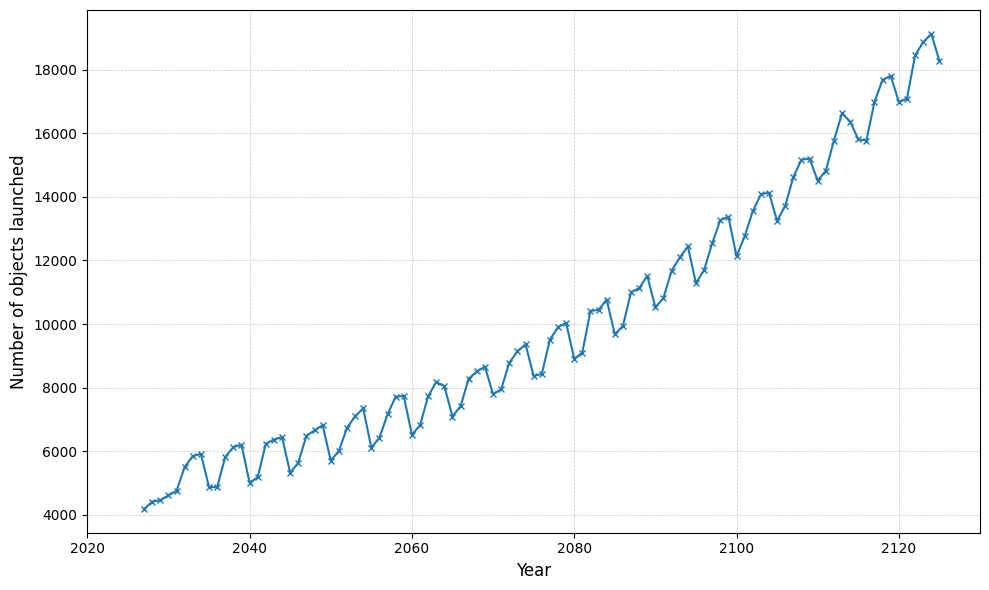
Fig 1: Future number of objects launched per year until the year 2125. This includes both constellation and non-constellation launches.
Tab 1: Future planned constellation launches considered in this scenario. After the constellations finish their launch plans only replenishment contributes to future launches.
|
Constellation |
Info |
Launched/Planned |
First/Finish launch |
|
Starlink |
Internet access |
7655/12,000 |
2019/2029 |
|
Guo Wang |
Internet access |
29/12,992 |
2024/2034 |
Input Files
⬇️ Debris at initial conditions
⬇️ Intact objects (no future launches population)
⬇️ Intact objects (baseline population)
Output Files
Please fill these files before proceeding to upload the answers in the registration page:
⬇️ Number of objects per epoch
⬇️ Collision events over simulation
⬇️ Probabilities of collisions at different epochs and altitudes
Thank you!