Speaker
Description
At the previous RHTG meeting, we presented the history, initial design and construction of the Low Density Shock Tube (LDST), part of the Electric Arc Shock Tube (EAST) facility at NASA Ames. Since this meeting the LDST has become operational with one completed test series performed for Dragonfly entry to Titan and a second test series planned for comparing to shock radiation data in air mixtures collected in the 10.16 cm High Velocity Shock Tube (HVST) in EAST. LDST is a 54.3 cm diameter tube, with test section located 20.7 m from the primary diaphragm. The larger diameter LDST offsets a loss of test time expected at low pressures, allowing LDST to operate at lower density conditions than can be obtained in HVST. Additionally, LDST displays reduced shock deceleration due to a larger core to boundary layer ratio and a greater signal to noise ratio in absorption and emission due to increased optical pathlengths. This paper will discuss some of the initial results in LDST, including challenges of operation and comparison to HVST conditions.
The first significant challenge of operation is due to optical scattering within the tube, causing a significant signal in front of the shock that perturbs the target radiation measurement by as much as 30%. A detailed model of scattering is constructed which is consistent with the pre-shock signal being driven by diffuse scattering. The origin of diffusely scattered radiation covers a length scale that is several times larger than the tube diameter. Given that the measurement window in LDST is approximately 1/4th of the tube diameter, this requires knowledge of radiation sources that are not measured during the test. The model constructed shows that a simple correction of pre-shock signal subtraction is good to better than 10%. For future testing, a vacuum compatible black anodization is performed and this effect will be demonstrated in the coming test series.
A second operational challenge is an observed non-planarity at higher operation velocities. A similar issue observed in the old EAST LDST was attributed to poor quality of tube fabrication causing wave patterns in the tube. The fabrication issues are largely corrected in the new LDST, ruling out this phenomenon as a primary cause. Currently, this phenomenon is thought to be due to some of the specifics of the arc driver operation. To obtain complete discharge of the driver, it is necessary to fix the operating voltage above 20 kV, which limits the ability to tune the shock velocity by voltage modification. Instead, a mixture of Argon and Helium is used where the mixture ratio determines the velocity. At higher velocities, where the Helium ratio exceeds 60%, loss of planarity is observed. This roughly corresponds to where the radial fraction of Helium exceeds the diffusional mixing length with Argon, resulting in a stratified driver gas that travels faster on the side near the fill port. Strategies such as alternating gas load or increasing the driver gas mixing time have shown an initial improvement in planarity. Since then a dynamic driver gas mixing panel has been designed that will be used in the next test series, and efficacy of this approach will be discussed. Additionally, a 1 m buffer section, which is filled at higher pressure than the test gas, is being installed between the driver and driven section, which may help to planarize the shock interface and has been shown to improve test times in HVST.
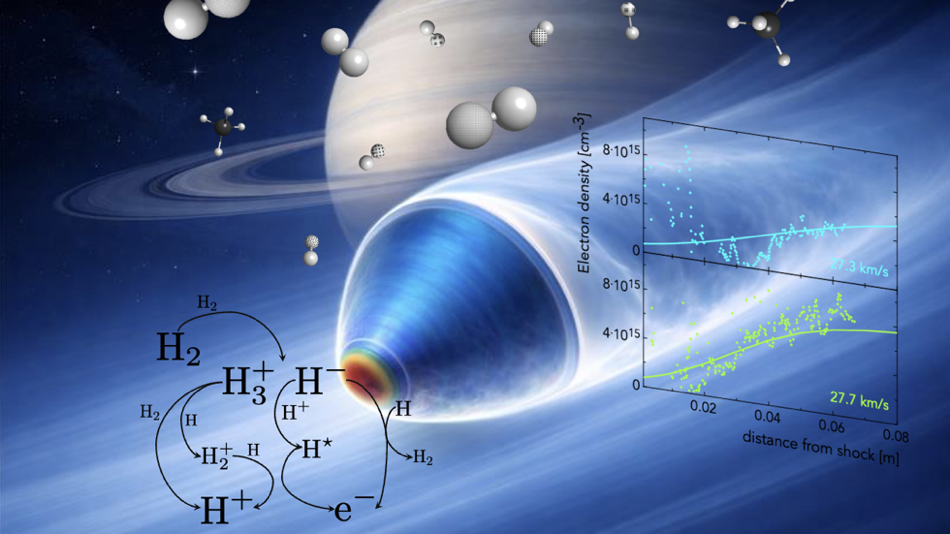
Data collected in the first LDST test series includes spatially resolved emission data around the CN Violet and Red features, time-resolved scanning diode laser absorption, microwave interferometry and broadband ultraviolet absorption spectroscopy. The emission and absorption data show temporal trends in CN number densities and temperatures. The magnitude of radiance has been demonstrated to show quantitative agreement to overlap conditions in HVST, provided the data is presented in terms of particle (or Lagrangian) time. These data will be briefly discussed. The initial tests of the upcoming test series will span from 3-5 km/s and will be covered in this talk. This includes infrared and ultraviolet measurements of NO radiation with concurrent laser and broadband absorption spectroscopies. The improved signal to noise in the infrared spectrum is hoped to resolve some discrepancies in NO temperature and state population analysis previously presented for these conditions. Subsequent tests in the 8-10 km/s range, examining areas of significant model disagreement around lunar return, are planned but will not be covered in this talk.
Summary
Review results in the NASA Ames Low Density Shock Tube, primarily for Dragonfly Entry