Description
Modelling of the Radiation Environment Near-Earth
-
Dr PAUL OBRIEN (The Aerospace Corporation)20/05/2025, 09:30
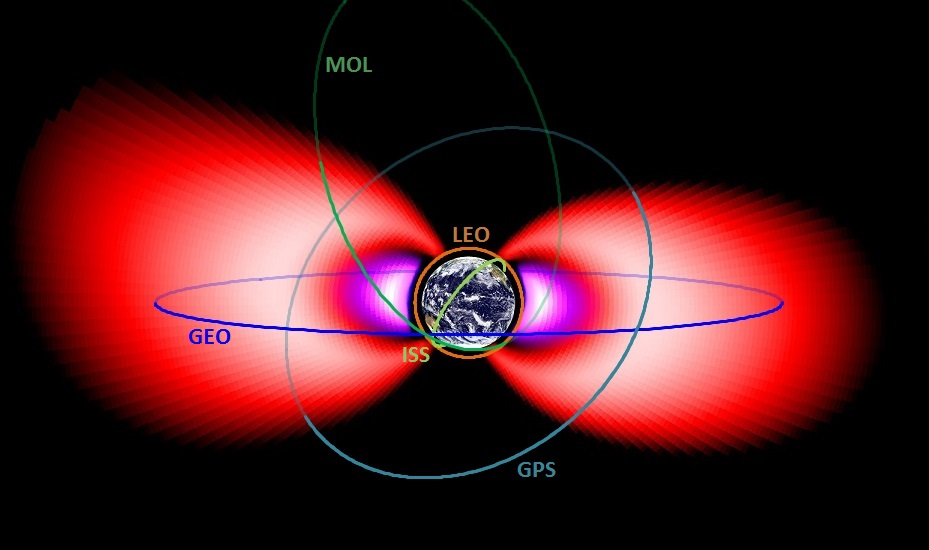
The International Radiation Environment Near Earth Model (IRENE), formerly AE9/AP9/SPM, has provided the global satellite design community with enhanced specification capabilities over legacy models since 2012. Based on feedback from the community we have continued to improve and expand capabilities of the model suite. We have recently released updates to version 1.5 providing more features...
Go to contribution page -
Angélica SICARD (ONERA)20/05/2025, 10:00
GREEN is a global model that combines local models developed at ONERA (IGE-2006, OPAL, OZONE, Slot,…) and AE/P8 for mission duration longer than 1 year. This model is solar-cycle dependent and can provide both mean and upper envelop fluxes, accounting for the dynamics between successive solar cycles. The objective of GREEN-NG, the new version of GREEN, is to replace the combination of local...
Go to contribution page -
Alexander Lozinski (Department of Atmospheric and Oceanic Sciences, UCLA, Los Angeles, CA, USA)20/05/2025, 10:20
A large proton belt enhancement occurred on 24 March 1991 following an interplanetary shock that impacted the dayside magnetopause at ~03:40 UT. Its formation was measured by the proton telescope aboard CRRES and attributed to the injection and inward transport of solar energetic particles (SEPs) by an azimuthally propagating electric field pulse induced by the shock’s compression of the...
Go to contribution page -
Shinji Saito (National Institute of Information and Communications Technology)20/05/2025, 10:40
We develop a radiation belt model by using probabilistic transport table that are calculated from test-particle simulations (GEMSIS-RBW). The parameters for the tables are L, background density constant along the field line, and chorus wave amplitude. The magnetic field is assumed to be the earth's dipole field. The two dimensional probabilistic table consists of the electron energy from 100...
Go to contribution page -
Antoine Brunet (ONERA)20/05/2025, 11:00
We present a novel statistical methodology for developing a radiation belt specification model that provides short- to long-term flux averages for spacecraft mission profiles, accounting for variability due to launch date and space weather/climate conditions. For this, we use an existing reanalysis database constructed using a physics-based radiation belt model and data assimilation. We...
Go to contribution page -
Prof. Yuri Shprits (GFZ German Research Centre for Geosciences)20/05/2025, 11:20
The European Union’s Horizon 2020 Prediction of Adverse effects of Geomagnetic storms and Energetic Radiation (PAGER) project was successfully concluded in 2023. This project provides real-time space weather forecasts initiated from solar observations as well as predictions of radiation in space and its effects on satellite infrastructure. Real-time predictions of particle radiation and cold...
Go to contribution page -
Dr Sigiava Aminalragia-Giamini (SPARC)20/05/2025, 12:00
The latest extension of the Solar Accumulated and Peak Proton and Heavy Ion Radiation Environment (SAPPHIRE) modelling suite is presented.
Go to contribution page
SAPPHIRE-2S is a probabilistic model for mission specification concerning Solar Energetic Particle (SEP) particle radiation.
It is based on the data of the latest version of the SEPEM Reference Dataset with the addition of newly curated data from the ACE,... -
Dr PAUL OBRIEN (The Aerospace Corporation)20/05/2025, 12:20
We investigate two significant challenges in climatological modeling: improving up on the local distributions at grid points in the models and modeling the spatio-temporal covariance structure. We propose the use of tabular local distributions, with extrapolation based on generalized gamma functions, with power-law transforms to represent the error distributions. The generalized gamma can...
Go to contribution page -
20/05/2025, 12:40
To include topics such as:
Go to contribution page
Differences in Approaches
Validation of Models with Different Methods
Possible Convergence of Models for Usage